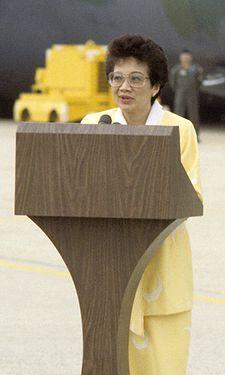
Former Philippine President Corazon Aquino Is Dead

225px-Cory_Aquino_during_a_ceremony_honoring_US_Air_ForceThis one is really striking a chord with me.

Corazon “Cory” Aquino, 11th President of the Philippines, died today, August 1, 2009.

Talk about the end of an era.

From the New York Times:

Corazon C. Aquino of the Philippines, who was swept into office on a wave of “people power” in 1986 and then faced down half a dozen coup attempts in six years as president, died Saturday in Manila, her son said. She was 76.

The NYTimes article is excellent, touching on many of the dramatic high points of Aquino’s life and service as president of the Philippines.  Who will ever forget the more than 2,500 pair of shoes left behind by Imelda Marcos, wife of former dictator Ferdinand Marcos, who lost election to Aquino in 1986?

What a thunderous moment in history.

More from the NYTimes:

An observant Roman Catholic who sometimes retreated to convents for contemplation, she attributed much of her success to a divine will. She also said she sought guidance from the spirit of her late husband, Benigno S. Aquino Jr., who had been a chief challenger to Mr. Marcos. His assassination in 1983 fueled the opposition against Mr. Marcos and made his widow a popular figure.

“What on earth do I know about being president?” Mrs. Aquino said in an interview in December 1985, after a rally opening her election campaign.

But that was beside the point. For many Filipinos, she embodied a hope of becoming a better nation and a prouder people.

“The only thing I can really offer the Filipino people is my sincerity,” she said in the interview.

It was what they hungered for, and what she delivered as president. Although often criticized as an indecisive and ineffectual leader, Mrs. Aquino combined passivity and stubbornness and an unexpected shrewdness to hold firm against powerful opponents from both the right and the left.

I recall an account of Aquino going to communion on her knees after her election.  Literally, according to accounts at the time, she processed down the aisle to the priest on her knees.  At the time, I thought that odd.  But Aquino attributed much of her success to divine will, and she strove to remain humble before her God.  Today, I consider that a striking image, contrary to leaders who have claimed to lead with a divine mandate, Aquino attempted to remain humble:

She had come to power through what amounted to popular acclaim — she called it “people power” — expressed by huge crowds that gathered in support of her after the disputed election in February 1986.

One year later, in February 1987, an 80 percent popular vote for a new Constitution was seen as a vote of confidence in her presidency, and coming after her nonelectoral ascent to power, it confirmed her legitimacy and helped keep her challengers at bay.

Hers is an amazing story.

She performed one incredible about-face in policy, however, that rattles the Philippines to this day:

Under pressure from her restive military, she was forced to abandon one of the most strongly held ideas she brought to her presidency, an amnesty and reconciliation with a Communist insurgency. In one of the most striking retreats of her presidency, addressing the graduating class at the Philippine Military Academy a year after taking power, she said, “The answer to the terrorism of the left and the right is not social and economic reform, but police and military action.”

She turned her military loose, and the war against the Communist New People’s Army resumed. The four-decade conflict continues today, along with widespread extrajudicial killings by the military that are reminiscent of Mr. Marcos’s time.

Her son says there will be no state funeral, according to ABS-CBN news in the Philippines:

The Aquinos have decided on a private funeral for the late President Corazon Aquino, who died early morning Saturday after battling colorectal cancer for more than a year.

Senator Benigno “Noynoy” Aquino III said they have decided to have a private funeral, instead of a state funeral.

“It won’t be a state funeral,” the senator said.

“That was the intention from the start,” he said, adding that nobody from the presidential office had contacted him “nor am I waiting to talk to anybody there.”

Aquino also said that they have not yet been contacted by Malacañang regarding any plans for a state funeral.

“For all intentions and purposes, she had been a private citizen after stepping down, and siguro, to a degree we would like to spend as much time as possible as a family with her,” he said, explaining their decision.

All I can say is that I’m incredibly touched by her passing.

I’ll end by letting the former president speak for herself through this prayer she wrote in 2004:

cory_yellowribbon

<p><strong>Prayer for a Happy Death (2004)</strong> <br />
by Corazon C. Aquino </p>
<p><em>Almighty God, most merciful Father<br />
You alone know the time<br />
You alone know the hour<br />
You alone know the moment<br />
When I shall breathe my last.</em></p>
<p><em>So remind me each day, most loving Father<br />
To be the best that I can be<br />
To be humble, to be kind,<br />
To be patient, to be true,<br />
To embrace what is good<br />
To reject what is evil<br />
To adore only You.</em></p>
<p><em>When that final moment does come<br />
Let not my loved ones grieve for long<br />
Let them comfort each other<br />
And let them know how much happiness<br />
They brought into my life.<br />
Let them pray for me<br />
As I will continue to pray for them,<br />
Hoping that they will always pray for each other.<br />
Let them know that they made possible<br />
Whatever good I offered to our world<br />
And let them realize that our separation<br />
Is just for a short while<br />
As we prepare for our reunion in eternity.</em></p>
<p><em>Our Father in heaven<br />
You alone are my hope<br />
You alone are my salvation<br />
Thank You for Your unconditional love. Amen.</em>
</p>

Prayer for a Happy Death (2004)
by Corazon C. Aquino

Almighty God, most merciful Father
You alone know the time
You alone know the hour
You alone know the moment
When I shall breathe my last.

So remind me each day, most loving Father
To be the best that I can be
To be humble, to be kind,
To be patient, to be true,
To embrace what is good
To reject what is evil
To adore only You.

When that final moment does come
Let not my loved ones grieve for long
Let them comfort each other
And let them know how much happiness
They brought into my life.
Let them pray for me
As I will continue to pray for them,
Hoping that they will always pray for each other.
Let them know that they made possible
Whatever good I offered to our world
And let them realize that our separation
Is just for a short while
As we prepare for our reunion in eternity.

Our Father in heaven
You alone are my hope
You alone are my salvation
Thank You for Your unconditional love. Amen.

Amen, indeed.

Stupid White Men Attack Wise Latina Supreme Court Nominee

Honestly, have you had enough of the stupid old white men repeatedly attacking Supreme Court nominee Sonia Sotomayor over her “wise latina” remark?  How can Republicans possibly waste the entire confirmation hearings focusing on speeches, and ignoring all of the nominee’s decisions?

Any Republicans reading this?  I’d love to know your “approval rating” of the stupid white men you sent to the United States Senate.  How can they dance for days without asking one substantive question?

From Salon.com:

By the sixth hour of the hearing, South Carolina Republican Lindsey Graham had dispensed with the formalities altogether. “If I may interject, Judge, [lawyers] find you difficult and challenging more than your colleagues,” Graham blurted, without irony. “Do you think you have a temperament problem?” A minute later, he had turned, weirdly, to personal advice: “Maybe these hearings are a time for self-reflection.” Graham also cautioned Sotomayor to “appreciate the world we live in,” in which she could say something about a “wise Latina” and still expect to win a seat on the Supreme Court — since white men wouldn’t be able to get away with similar remarks. And he led her through a ritualized denunciation of al-Qaida, asking how women would be treated if the jihadists had their way.

What made his performance even stranger, though, was that Graham is likely to vote for Sotomayor’s confirmation. “Now, let’s talk about you,” he told her, just before haranguing her about her temperament. “I like you, by the way, for whatever that matters. Since I may vote for you that ought to matter to you.”

Honestly, Lindsey Graham showed his idiotic side this week.  At times, he appeared juvenile in his attempts to bait the judge into an inappropriate remark.  Too bad for him.

I found one media report amusing this week: before television, there were no lengthy Supreme Court hearings.  Without a pulpit, these things just happened, and took little time.

Imagine that.

Judge Sonia Sotomayor will be confirmed and sworn in as a Supreme Court justice.  She seems firm but fair.  And she really knows the law.

That’s all we can ask.

Christian Extremist Allegedly Shoots, Kills Guard at Holocaust Museum

First, the chilling news from the New York Times:

An 88-year-old white supremacist with a rifle walked into the United States Holocaust Memorial Museum, one of the capital’s most visited sites, on Wednesday afternoon and began shooting, fatally wounding a security guard and sending tourists scrambling before he himself was shot, the authorities said.

The gunman was identified by law enforcement officials as James W. von Brunn, who embraces various conspiracy theories involving Jews, blacks and other minority groups and has at times waged a personal war with the federal government.

James W. von Brunn is 88 years old, currently listed in critical condition, according to CNN.

I’m not going to comment much.  The story is still raw, and a man died today.  The Holocaust Memorial Museum identified the deceased guard as Stephen Tyrone Johns.

According to CNN, the museum released a statement saying Johns died “heroically in the line of duty.”

“There are no words to express our grief and shock over these events. He served on the Museum’s security staff for six years. Our thoughts and prayers go out to Officer Johns’ family,” the statement said. “We have made the decision to close the Museum tomorrow in honor of Officer Johns, and our flags will be flown at half mast in his memory.”

The alleged shooter is a Christian extremist.  Read this disturbing passage from his book, Kill the Best Gentiles:

Under the Pharisees’ direction the Temple had become the Federal Reserve System of its day. Christ drove the usurers from the Temple with a snake whip, indirectly attacking the Pharisees’ purse. That sealed his fate! The Anti-Defamation League of his day acted quickly. Using standard procedures they defamed Jesus (“L’Infamie”) to get the mob on their side — as centuries later they would defame Marie Antoinette, the Romanovs, Hitler, Gen. MacArthur, McCarthy, et al). Then, Jesus was framed by the Sanhedrin, who had Him arrested, tried, sentenced, and crucified. (Pope John Paul, 1995 A.D., denied the HOLY WORD, pronouncing that JEWS had no part in the death of Jesus Christ!).

His blood be on us (JEWS) and upon our children! MATTHEW: 27:24-25.

I am innocent of the blood of this just man! THE SYNOPTICS: Pontius Pilate.

Other white supremicists seem to be worrying about their image, of all things.  This from someone who calls himself “Messiah” on a Web site called Stormfront, which proclaims the motto White Pride World Wide:

Most know the source of our problems are Jews and their desires to control the whole earth and all that is within it. They’re using our American government, and our money to accomplish that.

Now that being said, shooting up the Holocaust Museum will not change that.

NewPagan offers this:

What a Jackass move. This accomplished less than nothing and was just stupid and senseless all around. At least if he had targeted some people directly responsible for the financial collapse I could understand that.

As far as I’m concerned, Sorcerer gets the prize:

Dumbass thats just gonna make WN look stupid.   [sic]

Yup.  Real stupid.

That’s all I can read right now.  Personally, I’m going to spend a few moments in silent prayer reflecting on the loss today, working to focus back on the love.

Gov. Quinn Honors Fallen Soldiers Throughout the Year

I have to say, I’m impressed with Governor Quinn.  Not sure how successful he’ll be convincing the Illinois Legislature to pass his budget.  Frankly, bumping up the income tax is long overdue.  If there is any fairness in taxes, the income tax comes closest.

But that’s an argument for another time.

Today, I was  impressed to learn that Governor Quinn has attended funerals for all 30 Illinois soldiers killed in Afghanistan and Iraq over the past year.

Remember when we were criticizing President George Bush because he had not attended a single funeral for a fallen soldier?  His record remains unblemished.  Bush never attended any funerals.

I suppose there was stress enough sending young men and women to their deaths.  Now, the former president is relaxing, says it’s liberating to be out of office.

Liberating for us as well.

Another digression.  Back to Governor Quinn.

From the Sun-Times:

As the Memorial Day parade was set to kick off, Quinn stood with Mayor Daley in Daley Plaza handing out Gold Star banners to families of the 30 Illinois soldiers killed in Afghanistan and Iraq over the past year. Quinn has attended every funeral.

“I know all of them,” Quinn said. “Those funerals are heartbreaking days. We have one coming up Tuesday. We had one last Monday.”

But the state needs to also be concerned about the veterans returning from service. To best help them lawmakers need to fix the state’s broken funding systems, he said.

“Some . . . men and women coming back form Iraq need post-traumatic stress disorder help and counseling,” Quinn said. “We have a wonderful program, a national model. We can’t kick that program off to the side of the road because we don’t have money for it.”

I give the guy credit for showing up, standing in to honor the fallen, again and again and again.  Quinn puts his money where his mouth is.  That counts for something.

Sunday’s Chicago Tribune asks if Quinn can close the deal.  Can he pass his budget?

Two months after Gov. Pat Quinn proposed a $26 billion public works plan, he called top lawmakers into his office and asked them to give him a few projects in the massive bill that he could call his own.

The legislature’s top four leaders, including the fellow Democrats who control the House and Senate, turned down most of his suggestions.

The quiet scene in the governor’s office last Tuesday demonstrates perhaps the most important political dynamic in state government these days: Quinn’s struggle to harness the power of his new position and the willingness of wily legislative bosses to take the lead.

Lawmakers and others with a stake in Statehouse politics cheered Quinn’s call for a new level of cooperation when he replaced the divisive Rod Blagojevich in January. But now they are questioning the untested governor’s ability to engage in the nitty-gritty of legislative dealmaking — in short, to be a closer.

So far, it looks like legislators aren’t giving an inch.  The governor needs learn to play the Springfield game.

With a week left before the General Assembly adjourns for the summer, friend and foe alike say the governor has not taken charge on his signature issues — a dramatic call to close a $12 billion budget gap with a 50 percent increase in the income tax and a blue-ribbon plan to reform state government after the Blagojevich scandal.

They question why he hasn’t lobbied harder in the Capitol for his tax plan and say that members of his special reform panel often have had to fend for themselves on ethics recommendations.

“I would like to see a lot more vigor. I think [ethics reform] should be his issue. This should be the issue he owns,” Cynthia Canary, the director of the Illinois Campaign for Political Reform, said, noting Quinn’s long activist history as a self-styled reformer.

“A lot more vigor?” So the governor needs to dance for the legislature?

No, I don’t get it either.  Springfield must be a political minefield, that place where dreams go to die.

How many funerals of fallen soldiers have legislators attended over the past year?  Perhaps that’s not a fair quesiton, but Quinn showing up at funerals shows me that he’s grounded.  A brush with reality might be good for some legislators.

Text of President Barack Obama’s Speech at Notre Dame

president-barack-obama-notre-dame-051709-tspear

President Barack Obama receives an honorary degree from the University of Notre Dame Sunday. (Photo: Tim Spear)

Notre Dame, IN – Text of President Barack Obama’s commencement address Sunday as the University of Notre Dame in South Bend, Ind., as prepared for delivery. The Rev. John Jenkins is the school’s president. The Rev. Theodore Hesburgh is Jenkins’ predecessor.

The text of the speech follows:

Thank you, Father Jenkins, for that generous introduction. You are doing an outstanding job as president of this fine institution, and your continued and courageous commitment to honest, thoughtful dialogue is an inspiration to us all.

Good afternoon, Father Hesburgh, Notre Dame trustees, faculty, family, friends and the class of 2009. I am honored to be here today and grateful to all of you for allowing me to be part of your graduation.

I want to thank you for this honorary degree. I know it has not been without controversy. I don’t know if you’re aware of this, but these honorary degrees are apparently pretty hard to come by. So far I’m only 1 for 2 as president. Father Hesburgh is 150 for 150. I guess that’s better. Father Ted, after the ceremony, maybe you can give me some pointers on how to boost my average.

I also want to congratulate the class of 2009 for all your accomplishments. And since this is Notre Dame, I mean both in the classroom and in the competitive arena. We all know about this university’s proud and storied football team, but I also hear that Notre Dame holds the largest outdoor 5-on-5 basketball tournament in the world — Bookstore Basketball.

Now this excites me. I want to congratulate the winners of this year’s tournament, a team by the name of “Hallelujah Holla Back.” Well done. Though I have to say, I am personally disappointed that the “Barack O’Ballers” didn’t pull it out. Next year, if you need a 6-foot, 2-inch forward with a decent jumper, you know where I live.

Every one of you should be proud of what you have achieved at this institution. One hundred and sixty-three classes of Notre Dame graduates have sat where you are today. Some were here during years that simply rolled into the next without much notice or fanfare — periods of relative peace and prosperity that required little by way of sacrifice or struggle.

You, however, are not getting off that easy. Your class has come of age at a moment of great consequence for our nation and the world — a rare inflection point in history where the size and scope of the challenges before us require that we remake our world to renew its promise; that we align our deepest values and commitments to the demands of a new age. It is a privilege and a responsibility afforded to few generations — and a task that you are now called to fulfill.

This is the generation that must find a path back to prosperity and decide how we respond to a global economy that left millions behind even before this crisis hit — an economy where greed and short-term thinking were too often rewarded at the expense of fairness, and diligence, and an honest day’s work.

We must decide how to save God’s creation from a changing climate that threatens to destroy it. We must seek peace at a time when there are those who will stop at nothing to do us harm, and when weapons in the hands of a few can destroy the many. And we must find a way to reconcile our ever-shrinking world with its ever-growing diversity — diversity of thought, of culture and of belief.

In short, we must find a way to live together as one human family.

It is this last challenge that I’d like to talk about today. For the major threats we face in the 21st century — whether it’s global recession or violent extremism, the spread of nuclear weapons or pandemic disease — do not discriminate. They do not recognize borders. They do not see color. They do not target specific ethnic groups.

Moreover, no one person, or religion, or nation can meet these challenges alone. Our very survival has never required greater cooperation and understanding among all people from all places than at this moment in history.

Unfortunately, finding that common ground — recognizing that our fates are tied up, as Dr. King said, in a “single garment of destiny” — is not easy. Part of the problem, of course, lies in the imperfections of man — our selfishness, our pride, our stubbornness, our acquisitiveness, our insecurities, our egos; all the cruelties large and small that those of us in the Christian tradition understand to be rooted in original sin. We too often seek advantage over others. We cling to outworn prejudice and fear those who are unfamiliar. Too many of us view life only through the lens of immediate self-interest and crass materialism; in which the world is necessarily a zero-sum game. The strong too often dominate the weak, and too many of those with wealth and with power find all manner of justification for their own privilege in the face of poverty and injustice. And so, for all our technology and scientific advances, we see around the globe violence and want and strife that would seem sadly familiar to those in ancient times.

We know these things; and hopefully one of the benefits of the wonderful education you have received is that you have had time to consider these wrongs in the world, and grown determined, each in your own way, to right them. And yet, one of the vexing things for those of us interested in promoting greater understanding and cooperation among people is the discovery that even bringing together persons of good will, men and women of principle and purpose, can be difficult.

The soldier and the lawyer may both love this country with equal passion, and yet reach very different conclusions on the specific steps needed to protect us from harm. The gay activist and the evangelical pastor may both deplore the ravages of HIV/AIDS, but find themselves unable to bridge the cultural divide that might unite their efforts. Those who speak out against stem cell research may be rooted in admirable conviction about the sacredness of life, but so are the parents of a child with juvenile diabetes who are convinced that their son’s or daughter’s hardships can be relieved.

The question, then, is how do we work through these conflicts? Is it possible for us to join hands in common effort? As citizens of a vibrant and varied democracy, how do we engage in vigorous debate? How does each of us remain firm in our principles, and fight for what we consider right, without demonizing those with just as strongly held convictions on the other side?

Nowhere do these questions come up more powerfully than on the issue of abortion.

president-barack-obama-speech-notre-dame-051709-tspear

President Barack Obama addresses graduates at the University of Notre Dame. (Photo: Tim Spear)

As I considered the controversy surrounding my visit here, I was reminded of an encounter I had during my Senate campaign, one that I describe in a book I wrote called “The Audacity of Hope.” A few days after I won the Democratic nomination, I received an e-mail from a doctor who told me that while he voted for me in the primary, he had a serious concern that might prevent him from voting for me in the general election. He described himself as a Christian who was strongly pro-life, but that’s not what was preventing him from voting for me.

What bothered the doctor was an entry that my campaign staff had posted on my Web site — an entry that said I would fight “right-wing ideologues who want to take away a woman’s right to choose.” The doctor said that he had assumed I was a reasonable person, but that if I truly believed that every pro-life individual was simply an ideologue who wanted to inflict suffering on women, then I was not very reasonable. He wrote, “I do not ask at this point that you oppose abortion, only that you speak about this issue in fair-minded words.”

Fair-minded words.

After I read the doctor’s letter, I wrote back to him and thanked him. I didn’t change my position, but I did tell my staff to change the words on my Web site. And I said a prayer that night that I might extend the same presumption of good faith to others that the doctor had extended to me. Because when we do that — when we open our hearts and our minds to those who may not think like we do or believe what we do — that’s when we discover at least the possibility of common ground.

That’s when we begin to say, “Maybe we won’t agree on abortion, but we can still agree that this is a heart-wrenching decision for any woman to make, with both moral and spiritual dimensions. So let’s work together to reduce the number of women seeking abortions by reducing unintended pregnancies, and making adoption more available, and providing care and support for women who do carry their child to term. Let’s honor the conscience of those who disagree with abortion, and draft a sensible conscience clause, and make sure that all of our health care policies are grounded in clear ethics and sound science, as well as respect for the equality of women.”

Understand — I do not suggest that the debate surrounding abortion can or should go away. No matter how much we may want to fudge it — indeed, while we know that the views of most Americans on the subject are complex and even contradictory — the fact is that at some level, the views of the two camps are irreconcilable. Each side will continue to make its case to the public with passion and conviction. But surely we can do so without reducing those with differing views to caricature.

Open hearts. Open minds. Fair-minded words.

It’s a way of life that has always been the Notre Dame tradition. Father Hesburgh has long spoken of this institution as both a lighthouse and a crossroads. The lighthouse that stands apart, shining with the wisdom of the Catholic tradition, while the crossroads is where “differences of culture and religion and conviction can coexist with friendship, civility, hospitality and especially love.” And I want to join him and Father Jenkins in saying how inspired I am by the maturity and responsibility with which this class has approached the debate surrounding today’s ceremony.

This tradition of cooperation and understanding is one that I learned in my own life many years ago — also with the help of the Catholic Church.

I was not raised in a particularly religious household, but my mother instilled in me a sense of service and empathy that eventually led me to become a community organizer after I graduated college. A group of Catholic churches in Chicago helped fund an organization known as the Developing Communities Project, and we worked to lift up South Side neighborhoods that had been devastated when the local steel plant closed.

It was quite an eclectic crew. Catholic and Protestant churches. Jewish and African-American organizers. Working-class black and white and Hispanic residents. All of us with different experiences. All of us with different beliefs. But all of us learned to work side by side because all of us saw in these neighborhoods other human beings who needed our help — to find jobs and improve schools. We were bound together in the service of others.

And something else happened during the time I spent in those neighborhoods. Perhaps because the church folks I worked with were so welcoming and understanding; perhaps because they invited me to their services and sang with me from their hymnals; perhaps because I witnessed all of the good works their faith inspired them to perform, I found myself drawn — not just to work with the church, but to be in the church. It was through this service that I was brought to Christ.

At the time, Cardinal Joseph Bernardin was the archbishop of Chicago. For those of you too young to have known him, he was a kind and good and wise man. A saintly man. I can still remember him speaking at one of the first organizing meetings I attended on the South Side. He stood as both a lighthouse and a crossroads — unafraid to speak his mind on moral issues ranging from poverty, AIDS and abortion to the death penalty and nuclear war. And yet, he was congenial and gentle in his persuasion, always trying to bring people together; always trying to find common ground. Just before he died, a reporter asked Cardinal Bernardin about this approach to his ministry. And he said, “You can’t really get on with preaching the Gospel until you’ve touched minds and hearts.”

My heart and mind were touched by the words and deeds of the men and women I worked alongside with in Chicago. And I’d like to think that we touched the hearts and minds of the neighborhood families whose lives we helped change. For this, I believe, is our highest calling.

You are about to enter the next phase of your life at a time of great uncertainty. You will be called upon to help restore a free market that is also fair to all who are willing to work; to seek new sources of energy that can save our planet; to give future generations the same chance that you had to receive an extraordinary education. And whether as a person drawn to public service, or someone who simply insists on being an active citizen, you will be exposed to more opinions and ideas broadcast through more means of communications than have ever existed before. You will hear talking heads scream on cable, read blogs that claim definitive knowledge, and watch politicians pretend to know what they’re talking about. Occasionally, you may also have the great fortune of seeing important issues debated by well-intentioned, brilliant minds. In fact, I suspect that many of you will be among those bright stars.

In this world of competing claims about what is right and what is true, have confidence in the values with which you’ve been raised and educated. Be unafraid to speak your mind when those values are at stake. Hold firm to your faith and allow it to guide you on your journey. Stand as a lighthouse.

But remember too that the ultimate irony of faith is that it necessarily admits doubt. It is the belief in things not seen. It is beyond our capacity as human beings to know with certainty what God has planned for us or what he asks of us, and those of us who believe must trust that his wisdom is greater than our own.

This doubt should not push us away from our faith. But it should humble us. It should temper our passions, and cause us to be wary of self-righteousness. It should compel us to remain open, and curious, and eager to continue the moral and spiritual debate that began for so many of you within the walls of Notre Dame. And within our vast democracy, this doubt should remind us to persuade through reason, through an appeal whenever we can to universal rather than parochial principles, and most of all through an abiding example of good works, charity, kindness and service that moves hearts and minds.

For if there is one law that we can be most certain of, it is the law that binds people of all faiths and no faith together. It is no coincidence that it exists in Christianity and Judaism; in Islam and Hinduism; in Buddhism and humanism. It is, of course, the golden rule — the call to treat one another as we wish to be treated. The call to love. To serve. To do what we can to make a difference in the lives of those with whom we share the same brief moment on this earth.

So many of you at Notre Dame — by the last count, upwards of 80 percent — have lived this law of love through the service you’ve performed at schools and hospitals; international relief agencies and local charities. That is incredibly impressive, and a powerful testament to this institution. Now you must carry the tradition forward. Make it a way of life. Because when you serve, it doesn’t just improve your community, it makes you a part of your community. It breaks down walls. It fosters cooperation. And when that happens — when people set aside their differences to work in common effort toward a common good; when they struggle together, and sacrifice together, and learn from one another — all things are possible.

After all, I stand here today, as president and as an African-American, on the 55th anniversary of the day that the Supreme Court handed down the decision in Brown v. the Board of Education. Brown was of course the first major step in dismantling the separate but equal doctrine, but it would take a number of years and a nationwide movement to fully realize the dream of civil rights for all of God’s children. There were freedom rides and lunch counters and Billy clubs, and there was also a Civil Rights Commission appointed by President Eisenhower. It was the 12 resolutions recommended by this commission that would ultimately become law in the Civil Rights Act of 1964.

There were six members of the commission. It included five whites and one African-American; Democrats and Republicans; two Southern governors, the dean of a Southern law school, a Midwestern university president, and your own Father Ted Hesburgh, president of Notre Dame. They worked for two years, and at times, President Eisenhower had to intervene personally since no hotel or restaurant in the South would serve the black and white members of the commission together. Finally, when they reached an impasse in Louisiana, Father Ted flew them all to Notre Dame’s retreat in Land O’ Lakes, Wis., where they eventually overcame their differences and hammered out a final deal.

Years later, President Eisenhower asked Father Ted how on Earth he was able to broker an agreement between men of such different backgrounds and beliefs. And Father Ted simply said that during their first dinner in Wisconsin, they discovered that they were all fishermen. And so he quickly readied a boat for a twilight trip out on the lake. They fished, and they talked, and they changed the course of history.

I will not pretend that the challenges we face will be easy, or that the answers will come quickly, or that all our differences and divisions will fade happily away. Life is not that simple. It never has been.

But as you leave here today, remember the lessons of Cardinal Bernardin, of Father Hesburgh, of movements for change both large and small. Remember that each of us, endowed with the dignity possessed by all children of God, has the grace to recognize ourselves in one another; to understand that we all seek the same love of family and the same fulfillment of a life well-lived. Remember that in the end, we are all fishermen.

If nothing else, that knowledge should give us faith that through our collective labor, and God’s providence, and our willingness to shoulder each other’s burdens, America will continue on its precious journey towards that more perfect union. Congratulations on your graduation, may God bless you, and may God bless the United States of America.

Source: WhiteHouse.gov

Sanctimony Incarnate: Glendon Declines Notre Dame’s Laetare Medal

The University of Notre Dame’s Observer has the news:

Mary Ann Glendon declined acceptance of the University’s Laetare Medal in a letter to University President Fr. John Jenkins Monday, saying she was “dismayed” upon hearing Notre Dame is conferring an honorary degree upon President Barack Obama.

Her decision marks the first time the award has been accepted and then declined, according to Julie Flory, a University spokesperson.

In the letter, which was printed on “First Things,” an online journal about religion, culture and public life, Glendon said she was “profoundly moved” when she was selected to receive the Laetare Medal.

This is sanctimony incarnate.  Where were all of these pious Catholics when Torturer-in-Chief George W. Bush was awarded an honorary degree from the University of Notre Dame,  George W. Bush who started a war for oil, George W. Bush who is responsible for the deaths of hundreds of thousands of innocent Iraqis?

I’ll tell you where they were: these “Drill-Baby-Drill” Catholics were cheering when Bush came to Notre Dame.

As a Catholic and an alumnus of the University of Notre Dame, I offer three cheers again for Fr. Dan Jenky.  The Faculty Senate at Notre Dame supports Jenkins. The Notre Dame faculty has traditionally stood on the side of common sense, long ago expressing support for ND’s gay and lesbian students.

The Observer editors also blew it in the lead headline for this story: “Former U.S. Ambassador to Vatican ‘dismayed’ that Notre Dame will honor pro-abortion Obama.”

Nowhere does the story reference Glendon referring to President Obama as “pro-abortion.”  She may have said so in her letter to Jenky, but this is not a part of the story.

Here’s a wake-up call to the right wing: President Obama is not pro-abortion.  He’s pro-choice, a political position many believe is the best avenue to bring down the abortion numbers.  I have yet to meet the politician, pro-life, pro-choice, or moderate, who is pro-abortion.  No one wants to see more abortions.  No one wants to see a woman in the position where she even considers abortion, or feels compelled to get an abortion.

I’ll pray for Ms. Glendon, but make no mistake: this is pure, old-fashioned political grandstanding, a ploy of movement conservatives.

Maybe Glendon just wants to run for office.

Three Cheers as Old Notre Dame Invites Obama

As an alumnus of the University of Notre Dame, I was very pleased to hear that the University has invited President Barack Obama to deliver the 2009 Commencement Address.  I was in the room in 1985 when then-Gov. Mario Cuomo spoke at Washington Hall, presenting his views on abortion.   I still have my copy of his embargoed talk.

I applauded the University then, and I applaud them now as they invite the President to address the graduates.

Some Catholic groups are not so happy.  From The Observer online:

Several religious and pro-life groups nationwide are expressing outrage and threatening to protest in South Bend after the University announced President Barack Obama will deliver the 2009 Commencement address at Notre Dame’s graduation ceremony May 17.

Assistant Vice President for News and Information Dennis Brown told The Observer a rumor that University switchboards were overwhelmed with callers and had to be shut down Friday night is false – a claim made by a March 20 article on pewsitter.com.

Although many outside groups are protesting University President Fr. John Jenkins’ decision, The Observer reported in an Oct. 8, 2008 article that Obama led the student body with 52.6 percent of the vote in a mock election held by student government, in which 2,692 undergraduates and graduate students voted.

Further along in the article, we read, “A representative in the office of Cardinal Francis George, president of the USCCB, said Cardinal George declined to comment on the issue because Notre Dame is out of the organization’s jurisdiction.”

I’m sure the Bishop John D’Arcy of the Fort Wayne-South Bend diocese will weigh in.  He’s a frequent critic of the University.  But the University is doing the right thing.

I first met President Obama when he was running for the United States Senate, and was immediately convinced that he is a man of outstanding character and intellect.  I consider him a man of tremendous compassion.

I’m very proud of my Alma Mater today.  Three Cheers for Old Notre Dame!

President Obama’s Address to Joint Session of Congress

Remarks of President Barack Obama – As Prepared for Delivery
Address to Joint Session of Congress
Tuesday, February 24th, 2009

Madame Speaker, Mr. Vice President, Members of Congress, and the First Lady of the United States:

I’ve come here tonight not only to address the distinguished men and women in this great chamber, but to speak frankly and directly to the men and women who sent us here.

I know that for many Americans watching right now, the state of our economy is a concern that rises above all others.  And rightly so.  If you haven’t been personally affected by this recession, you probably know someone who has – a friend; a neighbor; a member of your family.  You don’t need to hear another list of statistics to know that our economy is in crisis, because you live it every day.  It’s the worry you wake up with and the source of sleepless nights.  It’s the job you thought you’d retire from but now have lost; the business you built your dreams upon that’s now hanging by a thread; the college acceptance letter your child had to put back in the envelope.  The impact of this recession is real, and it is everywhere.

But while our economy may be weakened and our confidence shaken; though we are living through difficult and uncertain times, tonight I want every American to know this:

We will rebuild, we will recover, and the United States of America will emerge stronger than before.

The weight of this crisis will not determine the destiny of this nation.  The answers to our problems don’t lie beyond our reach.  They exist in our laboratories and universities; in our fields and our factories; in the imaginations of our entrepreneurs and the pride of the hardest-working people on Earth.  Those qualities that have made America the greatest force of progress and prosperity in human history we still possess in ample measure.  What is required now is for this country to pull together, confront boldly the challenges we face, and take responsibility for our future once more.

Now, if we’re honest with ourselves, we’ll admit that for too long, we have not always met these responsibilities – as a government or as a people.  I say this not to lay blame or look backwards, but because it is only by understanding how we arrived at this moment that we’ll be able to lift ourselves out of this predicament.

The fact is, our economy did not fall into decline overnight.  Nor did all of our problems begin when the housing market collapsed or the stock market sank.  We have known for decades that our survival depends on finding new sources of energy.  Yet we import more oil today than ever before.  The cost of health care eats up more and more of our savings each year, yet we keep delaying reform.  Our children will compete for jobs in a global economy that too many of our schools do not prepare them for.  And though all these challenges went unsolved, we still managed to spend more money and pile up more debt, both as individuals and through our government, than ever before.

In other words, we have lived through an era where too often, short-term gains were prized over long-term prosperity; where we failed to look beyond the next payment, the next quarter, or the next election.  A surplus became an excuse to transfer wealth to the wealthy instead of an opportunity to invest in our future.  Regulations were gutted for the sake of a quick profit at the expense of a healthy market.  People bought homes they knew they couldn’t afford from banks and lenders who pushed those bad loans anyway.  And all the while, critical debates and difficult decisions were put off for some other time on some other day.

Well that day of reckoning has arrived, and the time to take charge of our future is here.

Now is the time to act boldly and wisely – to not only revive this economy, but to build a new foundation for lasting prosperity.  Now is the time to jumpstart job creation, re-start lending, and invest in areas like energy, health care, and education that will grow our economy, even as we make hard choices to bring our deficit down.  That is what my economic agenda is designed to do, and that’s what I’d like to talk to you about tonight.

It’s an agenda that begins with jobs.

As soon as I took office, I asked this Congress to send me a recovery plan by President’s Day that would put people back to work and put money in their pockets.  Not because I believe in bigger government – I don’t.  Not because I’m not mindful of the massive debt we’ve inherited – I am.  I called for action because the failure to do so would have cost more jobs and caused more hardships.  In fact, a failure to act would have worsened our long-term deficit by assuring weak economic growth for years.  That’s why I pushed for quick action.  And tonight, I am grateful that this Congress delivered, and pleased to say that the American Recovery and Reinvestment Act is now law.

Over the next two years, this plan will save or create 3.5 million jobs.  More than 90% of these jobs will be in the private sector – jobs rebuilding our roads and bridges; constructing wind turbines and solar panels; laying broadband and expanding mass transit.

Because of this plan, there are teachers who can now keep their jobs and educate our kids.  Health care professionals can continue caring for our sick.  There are 57 police officers who are still on the streets of Minneapolis tonight because this plan prevented the layoffs their department was about to make.

Because of this plan, 95% of the working households in America will receive a tax cut – a tax cut that you will see in your paychecks beginning on April 1st.

Because of this plan, families who are struggling to pay tuition costs will receive a $2,500 tax credit for all four years of college.  And Americans who have lost their jobs in this recession will be able to receive extended unemployment benefits and continued health care coverage to help them weather this storm.

I know there are some in this chamber and watching at home who are skeptical of whether this plan will work.  I understand that skepticism.  Here in Washington, we’ve all seen how quickly good intentions can turn into broken promises and wasteful spending.  And with a plan of this scale comes enormous responsibility to get it right.

That is why I have asked Vice President Biden to lead a tough, unprecedented oversight effort – because nobody messes with Joe.  I have told each member of my Cabinet as well as mayors and governors across the country that they will be held accountable by me and the American people for every dollar they spend.  I have appointed a proven and aggressive Inspector General to ferret out any and all cases of waste and fraud.  And we have created a new website called recovery.gov so that every American can find out how and where their money is being spent.

So the recovery plan we passed is the first step in getting our economy back on track.  But it is just the first step.  Because even if we manage this plan flawlessly, there will be no real recovery unless we clean up the credit crisis that has severely weakened our financial system.

I want to speak plainly and candidly about this issue tonight, because every American should know that it directly affects you and your family’s well-being.  You should also know that the money you’ve deposited in banks across the country is safe; your insurance is secure; and you can rely on the continued operation of our financial system.  That is not the source of concern.

The concern is that if we do not re-start lending in this country, our recovery will be choked off before it even begins.

You see, the flow of credit is the lifeblood of our economy.  The ability to get a loan is how you finance the purchase of everything from a home to a car to a college education; how stores stock their shelves, farms buy equipment, and businesses make payroll.

But credit has stopped flowing the way it should.  Too many bad loans from the housing crisis have made their way onto the books of too many banks.  With so much debt and so little confidence, these banks are now fearful of lending out any more money to households, to businesses, or to each other.  When there is no lending, families can’t afford to buy homes or cars.  So businesses are forced to make layoffs.  Our economy suffers even more, and credit dries up even further.

That is why this administration is moving swiftly and aggressively to break this destructive cycle, restore confidence, and re-start lending.

We will do so in several ways.  First, we are creating a new lending fund that represents the largest effort ever to help provide auto loans, college loans, and small business loans to the consumers and entrepreneurs who keep this economy running.

Second, we have launched a housing plan that will help responsible families facing the threat of foreclosure lower their monthly payments and re-finance their mortgages.  It’s a plan that won’t help speculators or that neighbor down the street who bought a house he could never hope to afford, but it will help millions of Americans who are struggling with declining home values – Americans who will now be able to take advantage of the lower interest rates that this plan has already helped bring about.  In fact, the average family who re-finances today can save nearly $2000 per year on their mortgage.

Third, we will act with the full force of the federal government to ensure that the major banks that Americans depend on have enough confidence and enough money to lend even in more difficult times.  And when we learn that a major bank has serious problems, we will hold accountable those responsible, force the necessary adjustments, provide the support to clean up their balance sheets, and assure the continuity of a strong, viable institution that can serve our people and our economy.

I understand that on any given day, Wall Street may be more comforted by an approach that gives banks bailouts with no strings attached, and that holds nobody accountable for their reckless decisions.  But such an approach won’t solve the problem.  And our goal is to quicken the day when we re-start lending to the American people and American business and end this crisis once and for all.

I intend to hold these banks fully accountable for the assistance they receive, and this time, they will have to clearly demonstrate how taxpayer dollars result in more lending for the American taxpayer.  This time, CEOs won’t be able to use taxpayer money to pad their paychecks or buy fancy drapes or disappear on a private jet.  Those days are over.

Still, this plan will require significant resources from the federal government – and yes, probably more than we’ve already set aside.  But while the cost of action will be great, I can assure you that the cost of inaction will be far greater, for it could result in an economy that sputters along for not months or years, but perhaps a decade.  That would be worse for our deficit, worse for business, worse for you, and worse for the next generation.  And I refuse to let that happen.

I understand that when the last administration asked this Congress to provide assistance for struggling banks, Democrats and Republicans alike were infuriated by the mismanagement and results that followed.  So were the American taxpayers.  So was I.

So I know how unpopular it is to be seen as helping banks right now, especially when everyone is suffering in part from their bad decisions.  I promise you – I get it.

But I also know that in a time of crisis, we cannot afford to govern out of anger, or yield to the politics of the moment.  My job – our job – is to solve the problem.  Our job is to govern with a sense of responsibility.  I will not spend a single penny for the purpose of rewarding a single Wall Street executive, but I will do whatever it takes to help the small business that can’t pay its workers or the family that has saved and still can’t get a mortgage.

That’s what this is about.  It’s not about helping banks – it’s about helping people.  Because when credit is available again, that young family can finally buy a new home.  And then some company will hire workers to build it.  And then those workers will have money to spend, and if they can get a loan too, maybe they’ll finally buy that car, or open their own business.  Investors will return to the market, and American families will see their retirement secured once more.  Slowly, but surely, confidence will return, and our economy will recover.

So I ask this Congress to join me in doing whatever proves necessary.  Because we cannot consign our nation to an open-ended recession.  And to ensure that a crisis of this magnitude never happens again, I ask Congress to move quickly on legislation that will finally reform our outdated regulatory system.  It is time to put in place tough, new common-sense rules of the road so that our financial market rewards drive and innovation, and punishes short-cuts and abuse.

The recovery plan and the financial stability plan are the immediate steps we’re taking to revive our economy in the short-term.  But the only way to fully restore America’s economic strength is to make the long-term investments that will lead to new jobs, new industries, and a renewed ability to compete with the rest of the world. The only way this century will be another American century is if we confront at last the price of our dependence on oil and the high cost of health care; the schools that aren’t preparing our children and the mountain of debt they stand to inherit.  That is our responsibility.

In the next few days, I will submit a budget to Congress.  So often, we have come to view these documents as simply numbers on a page or laundry lists of programs.  I see this document differently.  I see it as a vision for America – as a blueprint for our future.

My budget does not attempt to solve every problem or address every issue.  It reflects the stark reality of what we’ve inherited – a trillion dollar deficit, a financial crisis, and a costly recession.

Given these realities, everyone in this chamber – Democrats and Republicans – will have to sacrifice some worthy priorities for which there are no dollars.  And that includes me.

But that does not mean we can afford to ignore our long-term challenges.  I reject the view that says our problems will simply take care of themselves; that says government has no role in laying the foundation for our common prosperity.

For history tells a different story.  History reminds us that at every moment of economic upheaval and transformation, this nation has responded with bold action and big ideas.  In the midst of civil war, we laid railroad tracks from one coast to another that spurred commerce and industry.  From the turmoil of the Industrial Revolution came a system of public high schools that prepared our citizens for a new age.  In the wake of war and depression, the GI Bill sent a generation to college and created the largest middle-class in history.  And a twilight struggle for freedom led to a nation of highways, an American on the moon, and an explosion of technology that still shapes our world.

In each case, government didn’t supplant private enterprise; it catalyzed private enterprise.  It created the conditions for thousands of entrepreneurs and new businesses to adapt and to thrive.

We are a nation that has seen promise amid peril, and claimed opportunity from ordeal.  Now we must be that nation again.  That is why, even as it cuts back on the programs we don’t need, the budget I submit will invest in the three areas that are absolutely critical to our economic future:  energy, health care, and education.

It begins with energy.

We know the country that harnesses the power of clean, renewable energy will lead the 21st century.  And yet, it is China that has launched the largest effort in history to make their economy energy efficient.  We invented solar technology, but we’ve fallen behind countries like Germany and Japan in producing it.  New plug-in hybrids roll off our assembly lines, but they will run on batteries made in Korea.

Well I do not accept a future where the jobs and industries of tomorrow take root beyond our borders – and I know you don’t either.  It is time for America to lead again.

Thanks to our recovery plan, we will double this nation’s supply of renewable energy in the next three years.  We have also made the largest investment in basic research funding in American history – an investment that will spur not only new discoveries in energy, but breakthroughs in medicine, science, and technology.

We will soon lay down thousands of miles of power lines that can carry new energy to cities and towns across this country.  And we will put Americans to work making our homes and buildings more efficient so that we can save billions of dollars on our energy bills.

But to truly transform our economy, protect our security, and save our planet from the ravages of climate change, we need to ultimately make clean, renewable energy the profitable kind of energy.  So I ask this Congress to send me legislation that places a market-based cap on carbon pollution and drives the production of more renewable energy in America.  And to support that innovation, we will invest fifteen billion dollars a year to develop technologies like wind power and solar power; advanced biofuels, clean coal, and more fuel-efficient cars and trucks built right here in America.

As for our auto industry, everyone recognizes that years of bad decision-making and a global recession have pushed our automakers to the brink.  We should not, and will not, protect them from their own bad practices.  But we are committed to the goal of a re-tooled, re-imagined auto industry that can compete and win.  Millions of jobs depend on it.  Scores of communities depend on it.  And I believe the nation that invented the automobile cannot walk away from it.

None of this will come without cost, nor will it be easy.  But this is America.  We don’t do what’s easy.  We do what is necessary to move this country forward.

For that same reason, we must also address the crushing cost of health care.

This is a cost that now causes a bankruptcy in America every thirty seconds.  By the end of the year, it could cause 1.5 million Americans to lose their homes.  In the last eight years, premiums have grown four times faster than wages.  And in each of these years, one million more Americans have lost their health insurance.  It is one of the major reasons why small businesses close their doors and corporations ship jobs overseas.  And it’s one of the largest and fastest-growing parts of our budget.

Given these facts, we can no longer afford to put health care reform on hold.

Already, we have done more to advance the cause of health care reform in the last thirty days than we have in the last decade.  When it was days old, this Congress passed a law to provide and protect health insurance for eleven million American children whose parents work full-time.  Our recovery plan will invest in electronic health records and new technology that will reduce errors, bring down costs, ensure privacy, and save lives.  It will launch a new effort to conquer a disease that has touched the life of nearly every American by seeking a cure for cancer in our time.  And it makes the largest investment ever in preventive care, because that is one of the best ways to keep our people healthy and our costs under control.

This budget builds on these reforms.  It includes an historic commitment to comprehensive health care reform – a down-payment on the principle that we must have quality, affordable health care for every American.  It’s a commitment that’s paid for in part by efficiencies in our system that are long overdue.  And it’s a step we must take if we hope to bring down our deficit in the years to come.

Now, there will be many different opinions and ideas about how to achieve reform, and that is why I’m bringing together businesses and workers, doctors and health care providers, Democrats and Republicans to begin work on this issue next week.

I suffer no illusions that this will be an easy process.  It will be hard.  But I also know that nearly a century after Teddy Roosevelt first called for reform, the cost of our health care has weighed down our economy and the conscience of our nation long enough.  So let there be no doubt: health care reform cannot wait, it must not wait, and it will not wait another year.

The third challenge we must address is the urgent need to expand the promise of education in America.

In a global economy where the most valuable skill you can sell is your knowledge, a good education is no longer just a pathway to opportunity – it is a pre-requisite.

Right now, three-quarters of the fastest-growing occupations require more than a high school diploma.  And yet, just over half of our citizens have that level of education.  We have one of the highest high school dropout rates of any industrialized nation.  And half of the students who begin college never finish.

This is a prescription for economic decline, because we know the countries that out-teach us today will out-compete us tomorrow.  That is why it will be the goal of this administration to ensure that every child has access to a complete and competitive education – from the day they are born to the day they begin a career.

Already, we have made an historic investment in education through the economic recovery plan.  We have dramatically expanded early childhood education and will continue to improve its quality, because we know that the most formative learning comes in those first years of life.  We have made college affordable for nearly seven million more students.  And we have provided the resources necessary to prevent painful cuts and teacher layoffs that would set back our children’s progress.

But we know that our schools don’t just need more resources.  They need more reform.  That is why this budget creates new incentives for teacher performance; pathways for advancement, and rewards for success.  We’ll invest in innovative programs that are already helping schools meet high standards and close achievement gaps.  And we will expand our commitment to charter schools.

It is our responsibility as lawmakers and educators to make this system work.  But it is the responsibility of every citizen to participate in it.  And so tonight, I ask every American to commit to at least one year or more of higher education or career training.  This can be community college or a four-year school; vocational training or an apprenticeship.  But whatever the training may be, every American will need to get more than a high school diploma.  And dropping out of high school is no longer an option.  It’s not just quitting on yourself, it’s quitting on your country – and this country needs and values the talents of every American.  That is why we will provide the support necessary for you to complete college and meet a new goal:  by 2020, America will once again have the highest proportion of college graduates in the world.

I know that the price of tuition is higher than ever, which is why if you are willing to volunteer in your neighborhood or give back to your community or serve your country, we will make sure that you can afford a higher education.  And to encourage a renewed spirit of national service for this and future generations, I ask this Congress to send me the bipartisan legislation that bears the name of Senator Orrin Hatch as well as an American who has never stopped asking what he can do for his country – Senator Edward Kennedy.

These education policies will open the doors of opportunity for our children.  But it is up to us to ensure they walk through them.  In the end, there is no program or policy that can substitute for a mother or father who will attend those parent/teacher conferences, or help with homework after dinner, or turn off the TV, put away the video games, and read to their child.  I speak to you not just as a President, but as a father when I say that responsibility for our children’s education must begin at home.

There is, of course, another responsibility we have to our children.  And that is the responsibility to ensure that we do not pass on to them a debt they cannot pay.  With the deficit we inherited, the cost of the crisis we face, and the long-term challenges we must meet, it has never been more important to ensure that as our economy recovers, we do what it takes to bring this deficit down.

I’m proud that we passed the recovery plan free of earmarks, and I want to pass a budget next year that ensures that each dollar we spend reflects only our most important national priorities.

Yesterday, I held a fiscal summit where I pledged to cut the deficit in half by the end of my first term in office.  My administration has also begun to go line by line through the federal budget in order to eliminate wasteful and ineffective programs.  As you can imagine, this is a process that will take some time.  But we’re starting with the biggest lines.  We have already identified two trillion dollars in savings over the next decade.

In this budget, we will end education programs that don’t work and end direct payments to large agribusinesses that don’t need them.  We’ll eliminate the no-bid contracts that have wasted billions in Iraq, and reform our defense budget so that we’re not paying for Cold War-era weapons systems we don’t use.  We will root out the waste, fraud, and abuse in our Medicare program that doesn’t make our seniors any healthier, and we will restore a sense of fairness and balance to our tax code by finally ending the tax breaks for corporations that ship our jobs overseas.

In order to save our children from a future of debt, we will also end the tax breaks for the wealthiest 2% of Americans.  But let me perfectly clear, because I know you’ll hear the same old claims that rolling back these tax breaks means a massive tax increase on the American people:  if your family earns less than $250,000 a year, you will not see your taxes increased a single dime.  I repeat: not one single dime.  In fact, the recovery plan provides a tax cut – that’s right, a tax cut – for 95% of working families.  And these checks are on the way.

To preserve our long-term fiscal health, we must also address the growing costs in Medicare and Social Security.  Comprehensive health care reform is the best way to strengthen Medicare for years to come.  And we must also begin a conversation on how to do the same for Social Security, while creating tax-free universal savings accounts for all Americans.

Finally, because we’re also suffering from a deficit of trust, I am committed to restoring a sense of honesty and accountability to our budget.  That is why this budget looks ahead ten years and accounts for spending that was left out under the old rules – and for the first time, that includes the full cost of fighting in Iraq and Afghanistan.  For seven years, we have been a nation at war.  No longer will we hide its price.

We are now carefully reviewing our policies in both wars, and I will soon announce a way forward in Iraq that leaves Iraq to its people and responsibly ends this war.

And with our friends and allies, we will forge a new and comprehensive strategy for Afghanistan and Pakistan to defeat al Qaeda and combat extremism.  Because I will not allow terrorists to plot against the American people from safe havens half a world away.

As we meet here tonight, our men and women in uniform stand watch abroad and more are readying to deploy. To each and every one of them, and to the families who bear the quiet burden of their absence, Americans are united in sending one message: we honor your service, we are inspired by your sacrifice, and you have our unyielding support.  To relieve the strain on our forces, my budget increases the number of our soldiers and Marines. And to keep our sacred trust with those who serve, we will raise their pay, and give our veterans the expanded health care and benefits that they have earned.

To overcome extremism, we must also be vigilant in upholding the values our troops defend – because there is no force in the world more powerful than the example of America. That is why I have ordered the closing of the detention center at Guantanamo Bay, and will seek swift and certain justice for captured terrorists – because living our values doesn’t make us weaker, it makes us safer and it makes us stronger.  And that is why I can stand here tonight and say without exception or equivocation that the United States of America does not torture.

In words and deeds, we are showing the world that a new era of engagement has begun.  For we know that America cannot meet the threats of this century alone, but the world cannot meet them without America.  We cannot shun the negotiating table, nor ignore the foes or forces that could do us harm.  We are instead called to move forward with the sense of confidence and candor that serious times demand.

To seek progress toward a secure and lasting peace between Israel and her neighbors, we have appointed an envoy to sustain our effort.  To meet the challenges of the 21st century – from terrorism to nuclear proliferation; from pandemic disease to cyber threats to crushing poverty – we will strengthen old alliances, forge new ones, and use all elements of our national power.

And to respond to an economic crisis that is global in scope, we are working with the nations of the G-20 to restore confidence in our financial system, avoid the possibility of escalating protectionism, and spur demand for American goods in markets across the globe.  For the world depends on us to have a strong economy, just as our economy depends on the strength of the world’s.

As we stand at this crossroads of history, the eyes of all people in all nations are once again upon us – watching to see what we do with this moment; waiting for us to lead.

Those of us gathered here tonight have been called to govern in extraordinary times.  It is a tremendous burden, but also a great privilege – one that has been entrusted to few generations of Americans.  For in our hands lies the ability to shape our world for good or for ill.

I know that it is easy to lose sight of this truth – to become cynical and doubtful; consumed with the petty and the trivial.

But in my life, I have also learned that hope is found in unlikely places; that inspiration often comes not from those with the most power or celebrity, but from the dreams and aspirations of Americans who are anything but ordinary.

I think about Leonard Abess, the bank president from Miami who reportedly cashed out of his company, took a $60 million bonus, and gave it out to all 399 people who worked for him, plus another 72 who used to work for him.  He didn’t tell anyone, but when the local newspaper found out, he simply said, ”I knew some of these people since I was 7 years old.  I didn’t feel right getting the money myself.”

I think about Greensburg, Kansas, a town that was completely destroyed by a tornado, but is being rebuilt by its residents as a global example of how clean energy can power an entire community – how it can bring jobs and businesses to a place where piles of bricks and rubble once lay.  “The tragedy was terrible,” said one of the men who helped them rebuild.  “But the folks here know that it also provided an incredible opportunity.”

And I think about Ty’Sheoma Bethea, the young girl from that school I visited in Dillon, South Carolina – a place where the ceilings leak, the paint peels off the walls, and they have to stop teaching six times a day because the train barrels by their classroom.  She has been told that her school is hopeless, but the other day after class she went to the public library and typed up a letter to the people sitting in this room.  She even asked her principal for the money to buy a stamp.  The letter asks us for help, and says, “We are just students trying to become lawyers, doctors, congressmen like yourself and one day president, so we can make a change to not just the state of South Carolina but also the world.  We are not quitters.”

We are not quitters.

These words and these stories tell us something about the spirit of the people who sent us here.  They tell us that even in the most trying times, amid the most difficult circumstances, there is a generosity, a resilience, a decency, and a determination that perseveres; a willingness to take responsibility for our future and for posterity.

Their resolve must be our inspiration.  Their concerns must be our cause.  And we must show them and all our people that we are equal to the task before us.

I know that we haven’t agreed on every issue thus far, and there are surely times in the future when we will part ways.  But I also know that every American who is sitting here tonight loves this country and wants it to succeed.  That must be the starting point for every debate we have in the coming months, and where we return after those debates are done.  That is the foundation on which the American people expect us to build common ground.

And if we do – if we come together and lift this nation from the depths of this crisis; if we put our people back to work and restart the engine of our prosperity; if we confront without fear the challenges of our time and summon that enduring spirit of an America that does not quit, then someday years from now our children can tell their children that this was the time when we performed, in the words that are carved into this very chamber, “something worthy to be remembered.”  Thank you, God Bless you, and may God Bless the United States of America.

Source: Whitehouse.gov

Barack Obama: Energy, Health Care, and Education

Note: This is a “progressive post,” constantly updated throughout the State of the Union Address.

President Barack Obama is providing Congress vision and direction tonight: energy, health care, and education.

I just realized tonight how much Congress needs this vision, this direction.

“We can’t afford to put health care on hold.  We can’t do it.  It’s time.”

Shame on the Republicans, sitting on their rear ends when the president speaks about recent legislation passed providing health care for children.  Shame on them all.

Two key lines from the president:

“We must have quality, affordable health care for every American,” the president said.

“Health care reform cannot wait, it must not wait, and it will not wait another year.”

On education:

“I ask every American to commit to at least one year of higher education.”

“This country values the needs and talents of every American.”

New goal: by 2020 American will once again have the largest percentage of college graduates in the world.

“In the end, there is no program or policy that can substitute for a parent.”

“I speak to you not only as a president, but as a father: responsibility for our children’s education must begin at home.”

On the national debt:

“We have a responsibility to our children to ensure that we do not pass on to them a debt that they cannot afford to pay.”

Applause after this line: “With a deficit we inherited…”

That applause came from the Dems.

“We have already identified two trillion dollars in savings over the next decade,” the president said.

“We’ll eliminate the no-bid contracts that have wasted billions in Iraq!”  Thank you!!!

Obama vows to end tax breaks for corporations “that ship our jobs over seas.”  Thank you!

“If your family earns less than $250,000, a quarter million dollars, you will not see your taxes increase a single dime.”

Boy, he’s gotta stick to that one.  That line will get a lot of play over the next several weeks.

Vows to honestly budget the wars in Iraq in Afghanistan: “For seven years, we’ve been a nation at war.  No longer will we hide its price!”

I didn’t even know the wars were not reflecting in previous budgets.

“I will not allow terrorists to plot against Americans from safe-havens half way around the world.  We will not allow it!”

Long, loud applause for those in the armed services.

Vows to raise the pay for those in the military, and give veterans the expanded health care “that they have earned.”

Thank you!

“The United States of America does not torture.”

We’ve waited so long to hear that.

Applause for the bank executive who gave his $60 million bonus away to his employees and former employees.  I applaud that as well.

Loud applause for the young girl who wrote congress about her school.

The president chooses to view crisis as opportunity.

Loud and lengthy applause.