Rep. Broun Calls Civil War ‘The Great War Of Yankee Aggression’ (Video)

Still fighting the Civil War, and apparently unhappy that his children and grandchildren will live in a country with a better health care system than he did before entering Congress, Rep. Paul Broun (R-GA) calls the Civil War "The Great War of Yankee Aggression."

Enjoy the short video clip from Media Matters.

Health Care Battle Tipping In Obama’s Favor As Vote Nears

President Obama

What a nice headline to read in the Sun-Times: "Health care battle tipping in Obama’s favor as vote nears."

Sweeeeeeeeeeeeeet.

From the Chicago Sun-Times:

One by one, House Democratic fence-sitters began choosing sides Friday, and the long, turbulent struggle over landmark health care legislation tilted unmistakably in President Barack Obama’s direction.

In full campaign mode, his voice rising, the president all but claimed victory, declaring to a cheering audience in Virginia, "We are going to fix health care in America."

With the showdown vote set for Sunday in the House, Obama decided to make one final, personal appeal to rank-and-file Democrats, arranging a Saturday visit to the Capitol. Republicans, unanimous in opposition to the bill, complained anew about its cost and reach.

Under a complex — and controversial — procedure the Democrats have devised, a single vote probably will be held to send one bill to Obama for his signature and to ship a second, fix-it measure to the Senate for final passage in the next several days.

Democratic leaders and Obama focused last-minute lobbying efforts on two groups of Democrats, 37 who voted against an earlier bill in the House and 40 who voted for it only after first makingL sure it would include strict abortion limits that now have been modified.

Democratic leaders worked late Friday attempting to resolve the dispute over abortion. Rep. Bart Stupak, D-Mich., who succeeded last November in inserting strict anti-abortion language into the House bill, hopes to do so again. That prospect angered lawmakers who support abortion rights.

"We’re not going to vote for a bill that restricts a woman’s right to choose beyond current law," said Rep. Diana DeGette, D-Colo., as she left an evening meeting with Speaker Nancy Pelosi. Abortion opponents are divided over whether restrictions on taxpayer funding currently in the bill go far enough.

Reps. John Boccieri of Ohio, Scott Murphy of New York and Allen Boyd and Suzanne Kosmas of Florida became the latest Democrats to announce support for the bill after voting against an earlier version that passed, bringing the number of switches in favor of the bill to seven.

This is sweet, and it’s history in the making.

This vote will be historic. Fitting that it should come on a Sunday.

To all members currently serving in the United States Congress: Vote YES on this bill. Be a part of history-in-the-making.

FYI: the picture above, in XHTML language, is aligned to the CENTER. That’s where this bill really comes from: the CENTER.

Vote for it with confidence. Vote for AMERICA. Vote, that all "… might have life, and might have it abundantly."

Gov. Pat Quinn Eyeing Suburban Sen. Susan Garrett as Potential Running Mate

Susan Garrett

From the Chicago Tribune:

Veteran suburban lawmaker Sen. Susan Garrett has emerged as a leading choice of Democratic Gov. Pat Quinn to become his running mate, top party sources familiar with the discussions said today.

The 60-year-old from Lake Forest shares Quinn’s liberal views, and the governor believes she could help articulate his message as the lieutenant governor candidate in what’s already a contentious general election battle, said the sources, who asked not to be named so they don’t pre-empt Quinn.

Garrett acknowledged that she was contacted Sunday by the governor’s chief of staff, Jerry Stermer, about her interest in the post, then met privately with Quinn this week. Garrett said Thursday that she’s submitting an application to the Web site Democrats have set up for prospective lieutenant governor nominees.

The senator said she would bring an independence to the office, along with her promotion of ethics reforms at the Illinois Toll Highway Authority, clean water issues, health care and job creation.

Very interesting. The GOP would face an even steeper uphill battle, especially considering this:

Republican governor candidate Sen. Bill Brady of Bloomington is a conservative who has opposed abortion rights and expanded health coverage for women. Those views are considered a potential liability, particularly among moderate women in the still heavily Republican suburbs.

Springfield About to Lighten-Up on ‘Sexting’ Teens

Some common sense from Springfield via the Chicago Trib:

Students under 18 who use computers or cell phones to share nude photos of their peers would earn little more than a scolding under a measure the Illinois Senate approved Thursday to address the “sexting” phenomenon.

Offenders would not face criminal charges, but would get juvenile court supervision that could result in counseling or community service. The bill doesn’t address youths who send or receive racy photos if they don’t distribute them.

“We’re not trying to prosecute them if they keep it between themselves,” said Rep. Darlene Senger, R-Naperville, who got a similar bill through the Illinois House last week. “It’s when the third party is involved. That’s when you get the situations where so-and-so committed suicide because the picture got up everywhere.”

No, I do not think it is wise at all for young people to send nude pictures of themselves to each other, regardless of the medium they use. But face it: kids are stupid sometimes. They make incredible mistakes as juveniles, and that’s why the law treats them differently until they reach the incredible old age of 17 in Illinois, and even then law enforcement and prosecutors have discretion. The current law is insane. No adolescent should be marked for life as a registered sex offender for sexting.

I hope after this law passes, there will be reconsideration for those lads and lasses who have been condemned to a life of humiliation because of their stupid, but typically youthful, indiscretions.

CBO: Health-Care Reform Bill Cuts Deficit $1.3 Trillion Over 20 Years, Covers 95%

First, from Ezra Klein at the Washington Post:

Washington has spent the past week or so waiting for the Congressional Budget Office to release its preliminary estimate of the Senate bill with the reconciliation fixes. Not only are those numbers important for the debate, but Democratic leaders refuse to release the actual text of their changes until CBO releases the specifics of its analysis.

According to a Democratic source, CBO has finished its work and will release the official preliminary score later today. But here are the basic numbers: The bill will cost $940 billion over the first 10 years and reduce the deficit by $130 billion during that period. In the second 10 years — so, 2020 to 2029 — it will reduce the deficit by $1.2 trillion. The legislation will cover 32 million Americans, or 95 percent of the legal population.

To put this in context, that’s more deficit reduction than either the House or Senate bill, and more coverage than the Senate bill.

Next, from the New York Times:

U.S. House Majority Leader Steny Hoyer said on Thursday that proposed final healthcare legislation would cut the U.S. deficit by more than $100 billion over the first 10 years.

Hoyer told reporters that the Congressional Budget Office said the sweeping healthcare overhaul would cut the deficit by more than $1 trillion over the subsequent decade. The CBO is expected to release its official estimate of the cost of the Democratic-written legislation on Thursday.

This is good news for liberals, good news for conservatives, good news for all.

Would You Go Nude Hot-Tubbing With Utah GOP Rep. Kevin Garn? (Video)

Would you go nude hot-tubbing with Republican Rep. Kevin Garn of Utah?

First, the strange news from NPR:

Utah’s House majority leader resigned from the Legislature Saturday, two days after acknowledging he paid a woman $150,000 to keep quiet about a nude hot-tubbing incident that took place a quarter century ago when she was a teenager.

Republican Rep. Kevin Garn’s Thursday night confession came in a speech before House colleagues and stunned this conservative state. On Saturday, he apologized in an e-mail to House Speaker David Clark for becoming a distraction.

"After discussing this matter with my family, I have decided that it is in the best interests of them, my colleagues and the people of Utah," he wrote.

Garn, 55, acknowledged the indiscretion with the legal minor immediately after the Legislature adjourned for the session.

"Although we did not have any sexual contact, it was still clearly inappropriate — and it was my fault," he said from the House floor Thursday night.

Lawmakers responded with a standing ovation for his honesty and embraced him, a move some found offensive given the nature of what Garn was saying. In hindsight, the ovation may not have been the best move, but it shouldn’t be misconstrued to indicate support for unethical behavior, Clark said Saturday.

Garn told colleagues he paid the woman, Cheryl Maher, after she began contacting reporters about the incident during his unsuccessful bid for a congressional seat in 2002. Despite a confidentiality agreement, the now 40-year-old Maher began contacting local news media last week to retell her story about being naked with Garn when she was 15, he said Thursday.

It’s unclear whether Garn was 29 or 30 at the time of the incident. He’s more than 14 years older than Maher, who now lives in Derry, N.H.

This happened a quarter century ago. She was legal (at 15???). He was conservative and Republican. They were both nude. There was no sex. (Really???) He paid her $150,000 to keep silent. What could go wrong?

I honestly don’t know Rep. Kevin Garn at all. My favorite from all of this is from Utah Republican Party Chairman Dave Hansen, who says the party will bounce back from this and the January resignation of Senate Majority Leader Sheldon Killpack following his arrest on a charge of driving under the influence.

"I would’ve preferred neither one of them had happened, obviously, but they did," Hansen said of the Garn and Killpack resignations. "But I don’t think in the long run it’s going to have any effect."

That’s a nice attempt to spin bad news, but, somewhere along the line, we all have to surrender our sanctimony, on the left and the right.

Anyhow, enjoy the vintage Eddie Murphy video.

Remarks by President Obama on Health Care Reform, March 3, 2010 (Video and Text)

Washington, D.C.–March 3, 2010 – 1:50 P.M. EST

THE PRESIDENT: Thank you so much, all of you, for joining us today. And I want to thank Julie, Barbara, Roland, Stephen, Renee, and Christopher, standing behind me — physicians, physicians assistants, and nurses who understand how important it is for us to make much needed changes in our health care system.

I want to thank all of you who are here today. I want to specially recognize two people who have been working tirelessly on that — on this effort, my Secretary of Health and Human Services, Kathleen Sebelius — (applause) — as well as our quarterback for health reform out of the White House, Nancy-Ann DeParle. (Applause.)

We began our push to reform health insurance last March, in this room, with doctors and nurses who know the system best. And so it’s fitting to be joined by all of you as we bring this journey to a close.

Last Thursday, I spent seven hours at a summit where Democrats and Republicans engaged in a public and very substantive discussion about health care. This meeting capped off a debate that began with a similar summit nearly one year ago. And since then, every idea has been put on the table. Every argument has been made.

Everything there is to say about health care has been said — (laughter) — and just about everybody has said it. (Laughter.) So now is the time to make a decision about how to finally reform health care so that it works, not just for the insurance companies, but for America’s families and America’s businesses.

Now, where both sides say they agree is that the status quo is not working for the American people. Health insurance is becoming more expensive by the day. Families can’t afford it. Businesses can’t afford it. The federal government can’t afford it. Smaller businesses and individuals who don’t get coverage at work are squeezed especially hard. And insurance companies freely ration health care based on who’s sick and who’s healthy; who can pay and who can’t. That’s the status quo. That’s the system we have right now.

Democrats and Republicans agree that this is a serious problem for America. And we agree that if we do nothing -– if we throw up our hands and walk away -– it’s a problem that will only grow worse. Nobody disputes that. More Americans will lose their family’s health insurance if they switch jobs or lose their job. More small businesses will be forced to choose between health care and hiring. More insurance companies will deny people coverage who have preexisting conditions, or they’ll drop people’s coverage when they get sick and need it most. And the rising cost of Medicare and Medicaid will sink our government deeper and deeper and deeper into debt. On all of this we agree.

So the question is, what do we do about it?

On one end of the spectrum, there are some who’ve suggested scrapping our system of private insurance and replacing it with a government-run health care system. And though many other countries have such a system, in America it would be neither practical nor realistic.

On the other end of the spectrum, there are those, and this includes most Republicans in Congress, who believe the answer is to loosen regulations on the insurance industry — whether it’s state consumer protections or minimum standards for the kind of insurance they can sell. The argument is, is that that will somehow lower costs. I disagree with that approach. I’m concerned that this would only give the insurance industry even freer rein to raise premiums and deny care.

So I don’t believe we should give government bureaucrats or insurance company bureaucrats more control over health care in America. I believe it’s time to give the American people more control over their health care and their health insurance. I don’t believe we can afford to leave life-and-death decisions about health care to the discretion of insurance company executives alone. I believe that doctors and nurses and physician assistants like the ones in this room should be free to decide what’s best for their patients. (Applause.)

Now, the proposal I put forward gives Americans more control over their health insurance and their health care by holding insurance companies more accountable. It builds on the current system where most Americans get their health insurance from their employer. If you like your plan, you can keep your plan. If you like your doctor, you can keep your doctor. I can tell you as the father of two young girls, I would not want any plan that interferes with the relationship between a family and their doctor.

Essentially, my proposal would change three things about the current health care system. First, it would end the worst practices of insurance companies. No longer would they be able to deny your coverage because of a preexisting condition. No longer would they be able to drop your coverage because you got sick. No longer would they be able to force you to pay unlimited amounts of money out of your own pocket. No longer would they be able to arbitrarily and massively raise premiums like Anthem Blue Cross recently tried to do in California — up to 39 percent increases in one year in the individual market. Those practices would end.

Second, my proposal would give uninsured individuals and small business owners the same kind of choice of private health insurance that members of Congress get for themselves — because if it’s good enough for members of Congress, it’s good enough for the people who pay their salaries. (Applause.)

The reason federal employees get a good deal on health insurance is that we all participate in an insurance market where insurance companies give better coverage and better rates, because they get more customers. It’s an idea that many Republicans have embraced in the past, before politics intruded.

And my proposal says that if you still can’t afford the insurance in this new marketplace, even though it’s going to provide better deals for people than they can get right now in the individual marketplace, then we’ll offer you tax credits to do so — tax credits that add up to the largest middle-class tax cut for health care in history. After all, the wealthiest among us can already buy the best insurance there is, and the least well off are able to get coverage through Medicaid. So it’s the middle class that gets squeezed, and that’s who we have to help.

Now, it is absolutely true that all of this will cost some money — about $100 billion per year. But most of this comes from the nearly $2 trillion a year that America already spends on health care — but a lot of it is not spent wisely. A lot of that money is being wasted or spent badly. So within this plan, we’re going to make sure the dollars we spend go towards making insurance more affordable and more secure. We’re going to eliminate wasteful taxpayer subsidies that currently go to insurance and pharmaceutical companies; set a new fee on insurance companies that stand to gain a lot of money and a lot of profits as millions of Americans are able to buy insurance; and we’re going to make sure that the wealthiest Americans pay their fair share on Medicare.

The bottom line is our proposal is paid for. And all the new money generated in this plan goes back to small businesses and middle-class families who can’t afford health insurance. It would also lower prescription drug prices for seniors. And it would help train new doctors and nurses and physician assistants to provide care for American families.

Finally, my proposal would bring down the cost of health care for millions — families, businesses, and the federal government. We have now incorporated most of the serious ideas from across the political spectrum about how to contain the rising cost of health care — ideas that go after the waste and abuse in our system, especially in programs like Medicare. But we do this while protecting Medicare benefits, and extending the financial stability of the program by nearly a decade.

Our cost-cutting measures mirror most of the proposals in the current Senate bill, which reduces most people’s premiums and brings down our deficit by up to a trillion dollars over the next two decades — brings down our deficit. Those aren’t my numbers; those are the savings determined by the Congressional Budget Office, which is the Washington acronym for the nonpartisan, independent referee of Congress in terms of how much stuff costs. (Laughter.)

So that’s our proposal. This is where we’ve ended up. It’s an approach that has been debated and changed and I believe improved over the last year. It incorporates the best ideas from Democrats and Republicans — including some of the ideas that Republicans offered during the health care summit, like funding state grants on medical malpractice reform, and curbing waste and fraud and abuse in the health care system. My proposal also gets rid of many of the provisions that had no place in health care reform — provisions that were more about winning individual votes in Congress than improving health care for all Americans.

Now, despite all that we agree on and all the Republican ideas we’ve incorporated, many — probably most — Republicans in Congress just have a fundamental disagreement over whether we should have more or less oversight of insurance companies. And if they truly believe that less regulation would lead to higher quality, more affordable health insurance, then they should vote against the proposal I’ve put forward.

Now, some also believe that we should, instead of doing what I’m proposing, pursue a piecemeal approach to health insurance reform, where we tinker around the edges of this challenge for the next few years. Even those who acknowledge the problem of the uninsured say we just can’t afford to help them right now — which is why the Republican proposal only covers 3 million uninsured Americans while we cover over 31 million.

The problem with that approach is that unless everyone has access to affordable coverage, you can’t prevent insurance companies from denying coverage based on preexisting conditions; you can’t limit the amount families are forced to pay out of their own pockets. The insurance reforms rest on everybody having access to coverage.

And you also don’t do anything about the fact that taxpayers currently end up subsidizing the uninsured when they’re forced to go to the emergency room for care, to the tune of about a thousand bucks per family. You can’t get those savings if those people are still going to the emergency room. So the fact is, health reform only works if you take care of all of these problems at once.

Now, both during and after last week’s summit, Republicans in Congress insisted that the only acceptable course on health care reform is to start over. But given these honest and substantial differences between the parties about the need to regulate the insurance industry and the need to help millions of middle-class families get insurance, I don’t see how another year of negotiations would help.

Moreover, the insurance companies aren’t starting over. They’re continuing to raise premiums and deny coverage as we speak. For us to start over now could simply lead to delay that could last for another decade, or even more. The American people, and the U.S. economy, just can’t wait that long. So, no matter which approach you favor, I believe the United States Congress owes the American people a final vote on health care reform. (Applause.)

We have debated this issue thoroughly, not just for the past year but for decades. Reform has already passed the House with a majority. It has already passed the Senate with a supermajority of 60 votes. And now it deserves the same kind of up or down vote that was cast on welfare reform, that was cast on the Children’s Health Insurance Program, that was used for COBRA health coverage for the unemployed, and, by the way, for both Bush tax cuts — all of which had to pass Congress with nothing more than a simple majority.

I, therefore, ask leaders in both houses of Congress to finish their work and schedule a vote in the next few weeks. From now until then, I will do everything in my power to make the case for reform. (Applause.) And I urge every American who wants this reform to make their voice heard as well — every family, every business, every patient, every doctor, every nurse, every physician’s assistant. Make your voice heard.

This has been a long and wrenching debate. It has stoked great passions among the American people and their representatives. And that’s because health care is a difficult issue. It is a complicated issue. If it was easy, it would have been solved long ago. As all of you know from experience, health care can literally be an issue of life or death. And as a result, it easily lends itself to demagoguery and political gamesmanship, and misrepresentation and misunderstanding.

But that’s not an excuse for those of us who were sent here to lead. That’s not an excuse for us to walk away. We can’t just give up because the politics are hard. I know there’s been a fascination, bordering on obsession, in this media town about what passing health insurance reform would mean for the next election and the one after that. How will this play? What will happen with the polls? I will leave it to others to sift through the politics, because that’s not what this is about. That’s not why we’re here.

This is about what reform would mean for the mother with breast cancer whose insurance company will finally have to pay for her chemotherapy. This is about what reform would mean for the small business owner who will no longer have to choose between hiring more workers or offering coverage to the employees she has. This is about what reform would mean for middle-class families who will be able to afford health insurance for the very first time in their lives and get a regular checkup once in a while, and have some security about their children if they get sick.

This is about what reform would mean for all those men and women I’ve met over the last few years who’ve been brave enough to share their stories. When we started our push for reform last year, I talked to a young mother in Wisconsin named Laura Klitzka. She has two young children. She thought she had beaten her breast cancer but then later discovered it had spread to her bones. She and her husband were working and had insurance, but their medical bills still landed them in debt. And now she spends time worrying about that debt when all she wants to do is spend time with her children and focus on getting well.

This should not happen in the United States of America. And it doesn’t have to. (Applause.)

In the end, that’s what this debate is about. It’s about what kind of country we want to be. It’s about the millions of lives that would be touched and, in some cases, saved by making private health insurance more secure and more affordable.

So at stake right now is not just our ability to solve this problem, but our ability to solve any problem. The American people want to know if it’s still possible for Washington to look out for their interests and their future. They are waiting for us to act. They are waiting for us to lead. And as long as I hold this office, I intend to provide that leadership. I do not know how this plays politically, but I know it’s right. (Applause.)

And so I ask Congress to finish its work, and I look forward to signing this reform into law.

Thank you very much, everybody. Let’s get it done. (Applause.)

END
2:09 P.M. EST

Source: whitehouse.gov

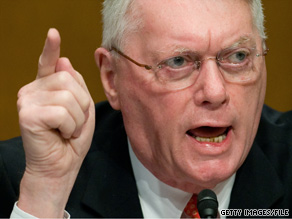
CNN: Sen. Jim Bunning Gives Journalist the Middle Finger

Senator Bunning

From CNN:

An angry Sen. Jim Bunning, R-Kentucky, refused to answer questions from CNN and ABC News Monday afternoon about his decision to block a bill that would extend unemployment benefits to millions of jobless Americans. An ABC News producer who was there says Bunning gave him the middle finger in response to a question.

CNN’s Dana Bash and a CNN camera crew tried to get Bunning to comment more extensively on the controversy on Monday. But the senator "got very angry," she said.

"Excuse me," the agitated senator told Bash while entering a Senate elevator. "I need to get to the (Senate) floor."

Moments earlier, and ABC News reporter and crew also attempted to question Bunning as he was getting on the Senate elevator.

A posting on the ABC News website details the exchange: "Excuse me! This is a Senator’s only elevator!" Bunning responded as he was asked a question by ABC’s Jonathan Karl.

"Excuse me!" Bunning yelled. "I’ve got to go to the floor!"

ABC News producer Z. Bryon Wolf spotted Bunning as he exited his office. When Wolf asked Bunning to stay and talk to cameras, Wolf says Bunning walked away and shot his middle finger over his head.

CNN reached out to Bunning’s office for comment. A spokesman for the senator said "I don’t have any comment," when asked about the obscene gesture.

Sen. Harry Reid asked him, "Where was my friend from Kentucky when we had two wars that were unpaid for during the Bush administration?"

"We don’t need lectures here on debt" from the GOP, he said. "There are poor people all over America who are desperate today."

Reid also mentioned the Bush administration tax cuts, which Democrats have said are unpaid for, according to CNN.

Suddenly, oh so suddenly, the Republicans are careful about spending money. Even for the unemployed.

About that middle finger thing? No doubt there are plenty of unemployed Americans saying, "Right back at’cha, Jim." Enjoy that Senator’s-only elevator while it lasts.

Durbin Ready to Pass Health Care Through Reconciliation If Necessary

From the Sun-Times:

Speaking at the opening of a community health center in the West Side Austin neighborhood Saturday, U.S. Sen. Richard Durbin (D-Illinois) said it’s “unfortunate” that senate Republicans won’t join Democratic efforts to pass a health care bill, but that the Democrats are ready to go it alone.

“I think they’re going to oppose our efforts,” said Durbin. “Now we have to get the job done.”

Durbin wouldn’t venture to predict predict when the bill will pass, but said he believed it will be “a matter of weeks, not months.”

Durbin noted that the process of “reconciliation” could be used as a way to improve a senate bill already passed.

I knew Durbin wouldn’t let us down. President Obama and the Democrats have opened every possible door for the Republicans to get involved and be part of the solution. Unfortunately, Republicans can only think in sound bytes.

The time for passing health care reform has finally arrived. May it happen soon.

Rep. Trent Franks: Blacks Better Off Under Slavery (Video and Text)

From Media Matters for America:

Arizona Congressman Trent Franks told blogger Mike Stark that African Americans were much better off under slavery. Franks, the most conservative member of the Republican caucus, who has in the past called the Supreme Court’s Roe v. Wade decision "the greatest holocaust in the history of mankind," is not new to conspiracy and bigotry.

Last October for example, Franks accused a prominent Muslim advocacy group of "trying to infiltrate the offices of members of Congress by placing interns in the offices." Franks, an on-again, off-again birther, has called president Obama "un-American," accused him of going "against American interests" and even called him "an enemy of humanity." His comments to Stark, as repulsive and abhorrent as they are, seem to be consistent with the reactionary mindset that some on the right hold.

FRANKS: In this country, we had slavery for God knows how long. And now we look back on it and we say "How brave were they? What was the matter with them? You know, I can’t believe, you know, four million slaves. This is incredible." And we’re right, we’re right. We should look back on that with criticism. It is a crushing mark on America’s soul. And yet today, half of all black children are aborted. Half of all black children are aborted. Far more of the African American community is being devastated by the policies of today than were being devastated by the policies of slavery. And I think, What does it take to get us to wake up?

No matter how you parse that, it comes out really, really wrong.

The excerpt starts at the 6:22 mark in the above video.