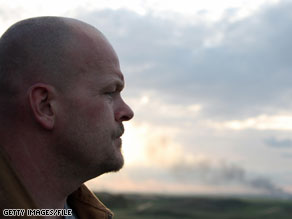
Joe the Plumber Says He’s Done with John McCain and Sarah Palin

Joe the Plumber

Joe "the Plumber" Wurzelbacher lashed out at Senator John McCain Saturday at a campaign rally Saturday in Pennsylvania for long shot gubernatorial candidate Sam Rohrer.

From CNN:

"John McCain is no public servant," Wurzelbacher said at a campaign rally Saturday in Pennsylvania for long shot gubernatorial candidate Sam Rohrer. Later, in an interview with Pennsylvania Public Radio, he dismissed the suggestion that he owes his fame to McCain.

"I don’t owe him s-," Wurzelbacher said. "He really screwed my life up, is how I look at it."

"McCain was trying to use me," he said. "I happened to be the face of middle Americans. It was a ploy."

Wurzelbacher is apparently finished with Sarah Palin as well since she is backing John McCain’s re-election bid in Arizona.

Apparently the Democrats aren’t the only ones turning on each other. The G.O.P. circular firing squad is in place.

Perhaps Wurzelbacher is trying to put together his own reactionary, right-wing, ultra-Libertarian campaign for some office somewhere? What party would have him?

Turns Out President Obama Never Forgot His Promise to Repeal ‘Don’t Ask, Don’t Tell’

gay soldiers

From the New York Times:

President Obama and top Pentagon officials met repeatedly over the past year about repealing “don’t ask, don’t tell,” the law that bans openly gay members of the military.

But it was in Oval Office strategy sessions to review court cases challenging the ban — ones that could reach the Supreme Court — that Mr. Obama faced the fact that if he did not change the policy, his administration would be forced to defend publicly the constitutionality of a law he had long opposed.

As a participant recounted one of the sessions, Mr. Obama told Defense Secretary Robert M. Gates and Adm. Mike Mullen, the chairman of the joint chiefs of staff, that the law was “just wrong.” Mr. Obama told them, the participant said, that he had delayed acting on repeal because the military was stretched in two wars and he did not want another polarizing debate in 2009 to distract from his health care fight.

But in 2010, he told them, this would be a priority. He got no objections.

On Tuesday, in the first Congressional hearing on the issue in 17 years, Mr. Gates and Admiral Mullen will unveil the Pentagon’s initial plans for carrying out a repeal, which requires an act of Congress. Gay rights leaders say they expect Mr. Gates to announce in the interim that the Defense Department will not take action to discharge service members whose sexual orientation is revealed by third parties or jilted partners, one of the most onerous aspects of the law. Pentagon officials had no comment.

Gay rights groups are calling the hearing historic even as they question how quickly the administration is prepared to act. But Republicans are already signaling that they are not eager to take up the issue.

I hope that our friends in these gay rights groups start to understand that the president was actually working on repealing the ban on gays in the military almost non-stop since taking office, meeting "repeatedly" with top Pentagon officials, in addition to talking about the wars the previous president started.

Maybe, just maybe, there’s more involved in being President of the United States than viewing everything through the lenses of one issue?

The ban should be repealed, and I hope it is soon.

I’m near the end of Frank Schaeffer’s Patience with God: Faith for People Who Don’t Like Religion (or Atheism). Schaeffer’s son John is a United States Marine. Near the end of the book, Frank writes a very compelling and stirring account of the boot camp process where one becomes a Marine. I was moved today as I read it, while walking on a treadmill for two miles. I plan on finding Schaeffer’s Keeping Faith: A Father-Son Story About Love and the U.S. Marine Corps.

When I was a child (to paraphrase St. Paul), I did not trust the military. Now that I am a man, I have an incredible respect for those who serve this country in uniform. Some liberals really go overboard slamming the military, and they should not. These men and women learn to move beyond preoccupation with the self. They think of the other, the platoon, the United States of America, before they think of themselves. Those in uniform are worthy of our respect and support.

Gays and lesbians are more than capable of serving openly, thinking of others first, the platoon, the United States of America, before they think of themselves. Gay and lesbian soldiers serve openly in the military of other countries every day.

Gay and lesbian soldiers have been serving the United States of America in the military for centuries. Let them finally and proudly serve openly.

Weekly Address: President Obama Pledges to Rein in Budget Deficits (Video and Text)

Washington, D.C.–January 30, 2010.

At this time last year, amidst headlines about banks on the verge of collapse and job losses of 700,000 a month, we received another troubling piece of news about our economy. Our economy was shrinking at an alarming rate – the largest six-month decline in 50 years. Our factories and farms were producing less; our businesses were selling less; and more job losses were on the horizon.

One year later, according to numbers released this past week, this trend has reversed itself. For the past six months, our economy has been growing again. And last quarter, it grew more quickly than at any time in the past six years.

This is a sign of progress. And it’s an affirmation of the difficult decisions we made last year to pull our financial system back from the brink and get our economy moving again.

But when so many people are still struggling – when one in ten Americans still can’t find work, and millions more are working harder and longer for less – our mission isn’t just to grow the economy. It’s to grow jobs for folks who want them, and ensure wages are rising for those who have them. It’s not just about improvements we see in quarterly statistics, but ones people feel in their daily lives – a bigger paycheck; more security; the ability to give your kids a decent shot in life and still have enough to retire one day yourself.

That’s why job creation will be our number one focus in 2010. We’ll put more Americans back to work rebuilding our infrastructure all across the country. And since the true engines of job creation are America’s businesses, I’ve proposed tax credits to help them hire new workers, raise wages, and invest in new plants and equipment. I also want to eliminate all capital gains taxes on small business investment, and help small businesses get the loans they need to open their doors and expand their operations.

But as we work to create jobs, it is critical that we rein in the budget deficits we’ve been accumulating for far too long – deficits that won’t just burden our children and grandchildren, but could damage our markets, drive up our interest rates, and jeopardize our recovery right now.

There are certain core principles our families and businesses follow when they sit down to do their own budgets. They accept that they can’t get everything they want and focus on what they really need. They make tough decisions and sacrifice for their kids. They don’t spend what they don’t have, and they make do with what they’ve got.

It’s time their government did the same. That’s why I’m pleased that the Senate has just restored the pay-as-you-go law that was in place back in the 1990s. It’s no coincidence that we ended that decade with a $236 billion surplus. But then we did away with PAYGO – and we ended the next decade with a $1.3 trillion deficit. Reinstating this law will help get us back on track, ensuring that every time we spend, we find somewhere else to cut.

I’ve also proposed a spending freeze, so that as we increase investments in things we need, like job creation and middle class tax cuts – we cut spending on those we don’t, like tax cuts for oil companies and investment fund managers, and programs that are redundant, obsolete, or simply ineffective. Spending related to Medicare, Medicaid, and Social Security will not be affected – and neither will national security – but all other discretionary government programs will.

Finally, I’ve called for a bi-partisan Fiscal Commission – a panel of Democrats and Republicans who would sit down and hammer out concrete deficit-reduction proposals by a certain deadline. Because we’ve heard plenty of talk and a lot of yelling on TV about deficits, and it’s now time to come together and make the painful choices we need to eliminate those deficits.

This past week, 53 Democrats and Republicans voted for this commission in the Senate. But it failed when seven Republicans who had co-sponsored this idea in the first place suddenly decided to vote against it.

Now, it’s one thing to have an honest difference of opinion about something. I will always respect those who take a principled stand for what they believe, even if I disagree with them.

But what I won’t accept is changing positions because it’s good politics. What I won’t accept is opposition for opposition’s sake. We cannot have a serious discussion and take meaningful action to create jobs and control our deficits if politicians just do what’s necessary to win the next election instead of what’s best for the next generation.

I’m ready and eager to work with anyone who’s serious about solving the real problems facing our people and our country. I welcome anyone who comes to the table in good faith to help get our economy moving again and fulfill this country’s promise. That’s why we were elected in the first place. That’s what the American people expect and deserve. And that’s what we must deliver.

Thank you.

Source: whitehouse.gov

Pennsylvania State Sen. John Eichelberger Introduces Anti-Gay Marriage Bill

From the Philadelphia Gay News:

About eight months after he pledged to introduce a bill that would institute a ban on same-sex marriage in the state constitution, Pennsylvania Sen. John Eichelberger (R-30th Dist.) has made good on his promise.

SB 707, which Eichelberger introduced Jan. 26, would add to the Pennsylvania Constitution the language: “Only a union of one man and one woman shall be valid and recognized as marriage.”

Eichelberger announced his intention to spearhead such an initiative last May, and Sen. Daylin Leach (D-17th Dist.) shortly thereafter introduced a measure that seeks to legalize same-sex marriage in the Keystone State.

To amend the constitution, both chambers of the state legislature would have to pass the so-called Marriage Protection Amendment in two consecutive sessions before the question is posed to voters.

I don’t get it at all. Gays and Lesbians want to do one of the most conservative things possible: get married.

Get over.

More here.

Obama Declares ‘I Don’t Quit’ in First State of the Union Address

From the Chicago Sun-Times:

Declaring “I don’t quit,”‘ an embattled President Barack Obama vowed in his first State of the Union address Wednesday night to make job growth his topmost priority and urged a divided Congress to boost the still-ailing economy with fresh stimulus spending. Defiant despite stinging setbacks, he said he would not abandon ambitious plans for longer-term fixes to health care, energy, education and more.

“Change has not come fast enough,” Obama said before a politician-packed House chamber and a TV audience of millions. “As hard as it may be, as uncomfortable and contentious as the debates may be, it’s time to get serious about fixing the problems that are hampering our growth.”

Obama looked to change the conversation from how his presidency is stalling — over the messy health care debate, a limping economy and the missteps that led to Christmas Day’s barely averted terrorist disaster — to how he is seizing the reins.

A chief demand was for lawmakers to press forward with his prized health care overhaul, which is in severe danger in Congress, and to resist the temptation to substitute a smaller-bore solution for the far-reaching changes he wants.

“Do not walk away from reform,” he implored. “Not now. Not when we are so close.”

Republicans applauded the president when he entered the chamber, and even craned their necks and welcomed Michelle Obama when she took her seat. But the warm feelings of bipartisanship disappeared early.

I don’t know how “embattled” President Obama is right now. Every president is “embattled.” I found the tone of the SOTU remarkable. But Congress needs to remember how to be a parliament, and they’re not there yet. Republicans say, “NO!” Democrats let the tail wag the dog and give up the fight. The intelligence factor in Congress is rather low right now, I fear, on both sides of the aisle. Republicans are too dumb to realize that there is more to life than cheap politics, and Democrats are too dumb to know how to make Congress work.

Too bad.

I’m glad this president does not “give up.” We still have work to do.

Christopher Hayes: Health Care Moving in the Right Direction

From Chris Hayes at The Nation:

For the first time since the Massachusetts debacle, I’m cautiously optimistic about the fate of health care reform. Here’s why: In the wake of Scott Brown’s election, what was most dispiriting was the total leadership vacuum and chaotic, every-man-for-himself atmosphere among congressional Democrats. There didn’t seem to be any hard consensus on what to do next. Some said: break it up into smaller pieces, radically pare down the bill, go back and find Republican support (ha!) or let the thing die. Every one of these options would actually spell the death of health care reform, and one of the most stunning legislative failures in recent memory. To even consider such a move seemed insane, and yet those of us paid to observe Congress have spent the last two weeks watching, with mouth agape, as congressional Democrats slowly raised a loaded gun to their collective mouths and volubly considered pulling the trigger.

But sanity has, tentatively, provisionally prevailed. After spending much of yesterday talking to folks on capitol hill, it’s clear there is increasingly consensus on a path forward: As I explained last night on Rachel Maddow, it involves a few steps, but is relatively straightforward. The House has to come up with a list of changes to the Senate bill that will get them to 218 votes (and will also pass muster with the procedural constraints of “reconciliation”. For more on that you can listen to last week’s episode of The Breakdown.) They then send those changes to the Senate leadership, which can pass them through reconciliation, a process that requires a simple majority. Once that process has moved forward or (better!) is completed, the House can then pass in quick succession the Senate bill, and the amended fix.

To be honest, I want to read this in depth later on.  Just placing a link to Hayes’ post here so I can come back to it later on.

But this is good news.

Weekly Address: President Obama Addresses This Week’s Supreme Court Decision (Video and Text)

Washington, D.C.–January 23, 2010.

One of the reasons I ran for President was because I believed so strongly that the voices of everyday Americans, hardworking folks doing everything they can to stay afloat, just weren’t being heard over the powerful voices of the special interests in Washington. And the result was a national agenda too often skewed in favor of those with the power to tilt the tables.

In my first year in office, we pushed back on that power by implementing historic reforms to get rid of the influence of those special interests. On my first day in office, we closed the revolving door between lobbying firms and the government so that no one in my administration would make decisions based on the interests of former or future employers. We barred gifts from federal lobbyists to executive branch officials. We imposed tough restrictions to prevent funds for our recovery from lining the pockets of the well-connected, instead of creating jobs for Americans. And for the first time in history, we have publicly disclosed the names of lobbyists and non-lobbyists alike who visit the White House every day, so that you know what’s going on in the White House – the people’s house.

We’ve been making steady progress. But this week, the United States Supreme Court handed a huge victory to the special interests and their lobbyists – and a powerful blow to our efforts to rein in corporate influence. This ruling strikes at our democracy itself. By a 5-4 vote, the Court overturned more than a century of law – including a bipartisan campaign finance law written by Senators John McCain and Russ Feingold that had barred corporations from using their financial clout to directly interfere with elections by running advertisements for or against candidates in the crucial closing weeks.

This ruling opens the floodgates for an unlimited amount of special interest money into our democracy. It gives the special interest lobbyists new leverage to spend millions on advertising to persuade elected officials to vote their way – or to punish those who don’t. That means that any public servant who has the courage to stand up to the special interests and stand up for the American people can find himself or herself under assault come election time. Even foreign corporations may now get into the act.

I can’t think of anything more devastating to the public interest. The last thing we need to do is hand more influence to the lobbyists in Washington, or more power to the special interests to tip the outcome of elections.

All of us, regardless of party, should be worried that it will be that much harder to get fair, common-sense financial reforms, or close unwarranted tax loopholes that reward corporations from sheltering their income or shipping American jobs off-shore.

It will make it more difficult to pass commonsense laws to promote energy independence because even foreign entities would be allowed to mix in our elections.

It would give the health insurance industry even more leverage to fend off reforms that would protect patients.

We don’t need to give any more voice to the powerful interests that already drown out the voices of everyday Americans.

And we don’t intend to. When this ruling came down, I instructed my administration to get to work immediately with Members of Congress willing to fight for the American people to develop a forceful, bipartisan response to this decision. We have begun that work, and it will be a priority for us until we repair the damage that has been done.

A hundred years ago, one of the great Republican Presidents, Teddy Roosevelt, fought to limit special interest spending and influence over American political campaigns and warned of the impact of unbridled, corporate spending. His message rings as true as ever today, in this age of mass communications, when the decks are too often stacked against ordinary Americans. And as long as I’m your President, I’ll never stop fighting to make sure that the most powerful voice in Washington belongs to you.

Source: whitehouse.gov

Weekly Address: Getting Our Money Back from Wall Street

Washington, D.C.–January 16, 2010.

Over the past two years, more than seven million Americans have lost their jobs. Countless businesses have been forced to shut their doors. Few families have escaped the pain of this terrible recession. Rarely does a day go by that I do not hear from folks who are hurting. That is why we have pushed so hard to rebuild this economy.

But even as we work tirelessly to dig our way out of this hole, it is important that we address what led us into such a deep mess in the first place. Much of the turmoil of this recession was caused by the irresponsibility of banks and financial institutions on Wall Street. These financial firms took huge, reckless risks in pursuit of short-term profits and soaring bonuses. They gambled with borrowed money, without enough oversight or regard for the consequences. And when they lost, they lost big. Little more than a year ago, many of the largest and oldest financial firms in the world teetered on the brink of collapse, overwhelmed by the consequences of their irresponsible decisions. This financial crisis nearly pulled the entire economy into a second Great Depression.

As a result, the American people – struggling in their own right – were placed in a deeply unfair and unsatisfying position. Even though these financial firms were largely facing a crisis of their own creation, their failure could have led to an even greater calamity for the country. That is why the previous administration started a program – the Troubled Asset Relief Program, or TARP – to provide these financial institutions with funds to survive the turmoil they helped unleash. It was a distasteful but necessary thing to do.

Many originally feared that most of the $700 billion in TARP money would be lost. But when my administration came into office, we put in place rigorous rules for accountability and transparency, which cut the cost of the bailout dramatically. We have now recovered most of the money we provided to the banks. That’s good news, but as far as I’m concerned, it’s not good enough. We want the taxpayers’ money back, and we’re going to collect every dime.

That is why, this week, I proposed a new fee on major financial firms to compensate the American people for the extraordinary assistance they provided to the financial industry. And the fee would be in place until the American taxpayer is made whole. Only the largest financial firms with more than $50 billion in assets will be affected, not community banks. And the bigger the firm – and the more debt it holds – the larger the fee. Because we are not only going to recover our money and help close our deficits; we are going to attack some of the banking practices that led to the crisis.

That’s important. The fact is, financial firms play an essential role in our economy. They provide capital and credit to families purchasing homes, students attending college, businesses looking to start up or expand. This is critical to our recovery. That is why our goal with this fee – and with the common-sense financial reforms we seek – is not to punish the financial industry. Our goal is to prevent the abuse and excess that nearly led to its collapse. Our goal is to promote fair dealings while punishing those who game the system; to encourage sustained growth while discouraging the speculative bubbles that inevitably burst. Ultimately, that is in the shared interest of the financial industry and the American people.

Of course, I would like the banks to embrace this sense of mutual responsibility. So far, though, they have ferociously fought financial reform. The industry has even joined forces with the opposition party to launch a massive lobbying campaign against common-sense rules to protect consumers and prevent another crisis.

Now, like clockwork, the banks and politicians who curry their favor are already trying to stop this fee from going into effect. The very same firms reaping billions of dollars in profits, and reportedly handing out more money in bonuses and compensation than ever before in history, are now pleading poverty. It’s a sight to see.

Those who oppose this fee say the banks can’t afford to pay back the American people without passing on the costs to their shareholders and customers. But that’s hard to believe when there are reports that Wall Street is going to hand out more money in bonuses and compensation just this year than the cost of this fee over the next ten years. If the big financial firms can afford massive bonuses, they can afford to pay back the American people.

Those who oppose this fee have also had the audacity to suggest that it is somehow unfair. That because these firms have already returned what they borrowed directly, their obligation is fulfilled. But this willfully ignores the fact that the entire industry benefited not only from the bailout, but from the assistance extended to AIG and homeowners, and from the many unprecedented emergency actions taken by the Federal Reserve, the FDIC, and others to prevent a financial collapse. And it ignores a far greater unfairness: sticking the American taxpayer with the bill.

That is unacceptable to me, and to the American people. We’re not going to let Wall Street take the money and run. We’re going to pass this fee into law. And I’m going to continue to work with Congress on common-sense financial reforms to protect people and the economy from the kind of costly and painful crisis we’ve just been through. Because after a very tough two years, after a crisis that has caused so much havoc, if there is one lesson that we can learn, it’s this: we cannot return to business as usual.

Thank you very much.

Source: whitehouse.gov

Complete Remarks by President Obama on Strengthening Intelligence, Aviation Security

Washington, D.C.–January 7, 2010– 4:34 P.M. EST

THE PRESIDENT: Good afternoon, everybody. The immediate reviews that I ordered after the failed Christmas terrorist attack are now complete. I was just briefed on the findings and recommendations for reform, and I believe it’s important that the American people understand the new steps that we’re taking to prevent attacks and keep our country safe.

This afternoon, my Counterterrorism and Homeland Security Advisor, John Brennan, will discuss his review into our terrorist watchlist system — how our government failed to connect the dots in a way that would have prevented a known terrorist from boarding a plane for America, and the steps we’re going to take to prevent that from happening again.

Secretary of Homeland Security Janet Napolitano will discuss her review of aviation screening, technology and procedures —- how that terrorist boarded a plane with explosives that could have killed nearly 300 innocent people, and how we’ll strengthen aviation security going forward.

So today I want to just briefly summarize their conclusions and the steps that I’ve ordered to address them.

In our ever-changing world, America’s first line of defense is timely, accurate intelligence that is shared, integrated, analyzed, and acted upon quickly and effectively. That’s what the intelligence reforms after the 9/11 attacks largely achieved. That’s what our intelligence community does every day. But, unfortunately, that’s not what happened in the lead-up to Christmas Day. It’s now clear that shortcomings occurred in three broad and compounding ways.

First, although our intelligence community had learned a great deal about the al Qaeda affiliate in Yemen — called al Qaeda in the Arabian Peninsula — that we knew that they sought to strike the United States and that they were recruiting operatives to do so — the intelligence community did not aggressively follow up on and prioritize particular streams of intelligence related to a possible attack against the homeland.

Second, this contributed to a larger failure of analysis —- a failure to connect the dots of intelligence that existed across our intelligence community and which, together, could have revealed that Abdulmutallab was planning an attack.

Third, this, in turn, fed into shortcomings in the watch-listing system which resulted in this person not being placed on the “no fly” list, thereby allowing him to board that plane in Amsterdam for Detroit.

In sum, the U.S. government had the information — scattered throughout the system — to potentially uncover this plot and disrupt the attack. Rather than a failure to collect or share intelligence, this was a failure to connect and understand the intelligence that we already had.

That’s why we took swift action in the immediate days following Christmas, including reviewing and updating the terrorist watchlist system and adding more individuals to the “no fly” list, and directing our embassies and consulates to include current visa information in their warnings of individuals with terrorist or suspected terrorist ties.

Today, I’m directing a series of additional corrective steps across multiple agencies. Broadly speaking, they fall into four areas.

First, I’m directing that our intelligence community immediately begin assigning specific responsibility for investigating all leads on high-priority threats so that these leads are pursued and acted upon aggressively — not just most of the time, but all of the time. We must follow the leads that we get. And we must pursue them until plots are disrupted. And that mean assigning clear lines of responsibility.

Second, I’m directing that intelligence reports, especially those involving potential threats to the United States, be distributed more rapidly and more widely. We can’t sit on information that could protect the American people.

Third, I’m directing that we strengthen the analytical process, how our analysis — how our analysts process and integrate the intelligence that they receive. My Director of National Intelligence, Denny Blair, will take the lead in improving our day-to-day efforts. My Intelligence Advisory Board will examine the longer-term challenge of sifting through vast universes of intelligence and data in our Information Age.

And finally, I’m ordering an immediate effort to strengthen the criteria used to add individuals to our terrorist watchlists, especially the “no fly” list. We must do better in keeping dangerous people off airplanes, while still facilitating air travel.

So taken together, these reforms will improve the intelligence community’s ability to collect, share, integrate, analyze, and act on intelligence swiftly and effectively. In short, they will help our intelligence community do its job even better and protect American lives.

But even the best intelligence can’t identify in advance every individual who would do us harm. So we need the security — at our airports, ports, and borders, and through our partnerships with other nations — to prevent terrorists from entering America.

At the Amsterdam airport, Abdulmutallab was subjected to the same screening as other passengers. He was required to show his documents — including a valid U.S. visa. His carry-on bag was X-rayed. He passed through a metal detector. But a metal detector can’t detect the kind of explosives that were sewn into his clothes.

As Secretary Napolitano will explain, the screening technologies that might have detected these explosives are in use at the Amsterdam airport, but not at the specific checkpoints that he passed through. Indeed, most airports in the world — and in the United States — do not yet have these technologies. Now, there’s no silver bullet to securing the thousands of flights into America each day, domestic and international. It will require significant investments in many areas. And that’s why, even before the Christmas attack, we increased investments in homeland security and aviation security. This includes an additional $1 billion in new systems and technologies that we need to protect our airports — more baggage screening, more passenger screening and more advanced explosive detection capabilities, including those that can improve our ability to detect the kind of explosive used on Christmas. These are major investments and they’ll make our skies safer and more secure.

As I announced this week, we’ve taken a whole range of steps to improve aviation screening and security since Christmas, including new rules for how we handle visas within the government and enhanced screening for passengers flying from, or through, certain countries.

And today, I’m directing that the Department of Homeland Security take additional steps, including: strengthening our international partnerships to improve aviation screening and security around the world; greater use of the advanced explosive detection technologies that we already have, including imaging technology; and working aggressively, in cooperation with the Department of Energy and our National Labs, to develop and deploy the next generation of screening technologies.

Now, there is, of course, no foolproof solution. As we develop new screening technologies and procedures, our adversaries will seek new ways to evade them, as was shown by the Christmas attack. In the never-ending race to protect our country, we have to stay one step ahead of a nimble adversary. That’s what these steps are designed to do. And we will continue to work with Congress to ensure that our intelligence, homeland security, and law enforcement communities have the resources they need to keep the American people safe.

I ordered these two immediate reviews so that we could take immediate action to secure our country. But in the weeks and months ahead, we will continue a sustained and intensive effort of analysis and assessment, so that we leave no stone unturned in seeking better ways to protect the American people.

I have repeatedly made it clear — in public with the American people, and in private with my national security team — that I will hold my staff, our agencies and the people in them accountable when they fail to perform their responsibilities at the highest levels.

Now, at this stage in the review process it appears that this incident was not the fault of a single individual or organization, but rather a systemic failure across organizations and agencies. That’s why, in addition to the corrective efforts that I’ve ordered, I’ve directed agency heads to establish internal accountability reviews, and directed my national security staff to monitor their efforts. We will measure progress. And John Brennan will report back to me within 30 days and on a regular basis after that. All of these agencies — and their leaders — are responsible for implementing these reforms. And all will be held accountable if they don’t.

Moreover, I am less interested in passing out blame than I am in learning from and correcting these mistakes to make us safer. For ultimately, the buck stops with me. As President, I have a solemn responsibility to protect our nation and our people. And when the system fails, it is my responsibility.

Over the past two weeks, we’ve been reminded again of the challenge we face in protecting our country against a foe that is bent on our destruction. And while passions and politics can often obscure the hard work before us, let’s be clear about what this moment demands. We are at war. We are at war against al Qaeda, a far-reaching network of violence and hatred that attacked us on 9/11, that killed nearly 3,000 innocent people, and that is plotting to strike us again. And we will do whatever it takes to defeat them.

And we’ve made progress. Al Qaeda’s leadership is hunkered down. We have worked closely with partners, including Yemen, to inflict major blows against al Qaeda leaders. And we have disrupted plots at home and abroad, and saved American lives.

And we know that the vast majority of Muslims reject al Qaeda. But it is clear that al Qaeda increasingly seeks to recruit individuals without known terrorist affiliations not just in the Middle East, but in Africa and other places, to do their bidding. That’s why I’ve directed my national security team to develop a strategy that addresses the unique challenges posed by lone recruits. And that’s why we must communicate clearly to Muslims around the world that al Qaeda offers nothing except a bankrupt vision of misery and death –- including the murder of fellow Muslims –- while the United States stands with those who seek justice and progress.

To advance that progress, we’ve sought new beginnings with Muslim communities around the world, one in which we engage on the basis of mutual interest and mutual respect, and work together to fulfill the aspirations that all people share — to get an education, to work with dignity, to live in peace and security. That’s what America believes in. That’s the vision that is far more powerful than the hatred of these violent extremists.

Here at home, we will strengthen our defenses, but we will not succumb to a siege mentality that sacrifices the open society and liberties and values that we cherish as Americans, because great and proud nations don’t hunker down and hide behind walls of suspicion and mistrust. That is exactly what our adversaries want, and so long as I am President, we will never hand them that victory. We will define the character of our country, not some band of small men intent on killing innocent men, women and children.

And in this cause, every one of us — every American, every elected official — can do our part. Instead of giving into cynicism and division, let’s move forward with the confidence and optimism and unity that defines us as a people. For now is not a time for partisanship, it’s a time for citizenship — a time to come together and work together with the seriousness of purpose that our national security demands.

That’s what it means to be strong in the face of violent extremism. That’s how we will prevail in this fight. And that’s how we will protect our country and pass it — safer and stronger — to the next generation.

Thanks very much.

END
4:47 P.M. EST

Source: whitehouse.gov