Need to Enter America Illegally? There’s an App for That!

This news comes from USA Today (never great for in-depth reporting):

Three California professors say they are developing a cellphone tool that uses GPS technology to help illegal immigrants safely cross the border.

The Transborder Immigrant Tool would help migrants find water in the deserts near the border and otherwise avoid getting lost in their treacherous trek north.

The Associated Press says the phone would be programmed to show where water stations are located and how far away they are.

"It’s about giving water to somebody who’s dying in the desert of dehydration," said Micha Cardenas, 32, a UCSD lecturer.

More from the Associated Press:

The effort is being done on the government’s dime — an irony not lost on the designers whose salaries are paid by the state of California.

"There are many, many areas in which every American would say I don’t like the way my tax dollars are being spent. Our answer to that is an in-your-face, so what?" says UCSD lecturer Brett Stalbaum, 33, a self-described news junkie who likens his role to chief technology officer.

Migrants walk for days in extreme heat, often eating tuna and crackers handed out at migrant shelters inMexico. On Arizona ranches, they sip desperately from bins used by cows when their water runs out.

Hundreds have perished each year since heightened U.S. border enforcement pushed migrants out of large cities like San Diego and El Paso, Texas, in the 1990s. In response, migrant sympathizers put jugs or even barrels of water in the desert.

The designers want to load inexpensive phones with GPS software that takes signals from satellite, independent of phone networks. Pressing a menu button displays water stations, with the distance to each. A user selects one and follows an arrow on the screen.

Some worry the software could lead migrants to damaged or abandoned water stations. Others wonder if it would lull them into a false sense of security or alert the Border Patrol and anti-illegal immigration activists to their whereabouts.

John Hunter, who has planted water barrels in California’s scorching Imperial Valley since the late 1990s, says vandals destroy about 40 of his 150 stations every year.

"My concern is for people who arrive and find (the water) doesn’t exist," he says.
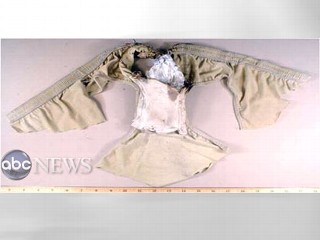
Courtesy the Associated Press, An Alleged Terrorist’s Underwear

Thanks to the Associated Press, you can now see that guy’s underwear.

From ABC News:

A singed pair of underwear with a packet of powder sewn into the crotch, seen in government photos obtained exclusively by ABC News, is all that remains of al Qaeda’s attempt to down an American passenger plane over Detroit.

As seen in these photos, the alleged bomb consisted of a packet of powder sewn into the briefs of Umar Farouk Abdulmutallab, a 23-year-old Nigerian. Al Qaeda took credit Monday for the attempted bombing, boasted of its ability to overcome U.S. intelligence and airport security, and promised new attacks.

The first photo, to the left, shows the slightly charred and singed underpants with the bomb packet still in place. All photos include a ruler to provide scale.

Now you have seen an alleged terrorist’s underwear. No alleged skid marks.

Amazing.

Is Orly Taitz Issuing Call to Arms Against President Obama?

Is birther Orly Taitz calling for a call to arms against President Obama?

Taitz has long ago pulled the fabricated Barack Obama birth certificate she once posted on her website. Her anger knows no bounds, however.

From her blog:

What is the real intention of this Kenyan, Indonesian communist usurper? Is it to provide security for us or to destroy our security? Judge for yourself.

Seeing targeted destruction of our economy, our security, dissipation of American jobs, massive corruption in the Government, Congress Department of Justice and Judiciary, it might be time to start rallies and protests using our second amendment right to bare arms and organise in militias.

"Kenyan, Indonesian communist usurper?" Really, Orly? And what exactly is meant by "protests using our second amendment right to bare arms and organise in militias?" Is Taitz calling for armed attacks against the President of the United States?

Taitz might indeed wish this was Kenya, which has had its share of armed military coups. Of course, in parts of Kenya, they burn witches.

This, however, is the United States of America, and Taitz has had a very, very bad year.

Christmas Day Terror Suspect Charged

From WTAE Pittsburgh:

The Justice Department has charged the alleged Christmas Day terrorist with attempting to destroy an airplane.

The Justice Department said 23-year-old Nigerian Umar Farouk Abdulmutallab had a device containing a high explosive attached to his body. The government says that as the flight neared Detroit Metropolitan Airport on Friday, Abdulmutallab set off the device, but it sparked a fire instead of an explosion.

According to an affidavit filed in federal court in Detroit, a preliminary analysis of the device shows that it contained PETN, also known as pentaerythritol.

The government alleges that Abdulmutallab told passengers that his stomach was upset, then pulled a blanket over himself. Passengers then heard popping noises.

He allegedly claimed to have been instructed by al-Qaida to detonate the plane over U.S. soil.

Imagine using the justice system to prosecute alleged terrorists! Send him to Guantanamo without a trial and throw away the key!

Maybe not. Perhaps this still is America, with justice for all.

Firecracker Story Was Really Terrorist Attempt to Blow Up Plane (Maybe)

The media botched this one again. First, this was just a guy who set off a firecracker on an airplane. No act of terror. I heard that on several reports.

Later, we learned more. Turns out the media was once again trying to give us the definitive report before they actually had all the facts, on the hope that they would be right.

Well, it would appear that this was an act of terror. I waited a while to blog on this because the story changed so often.

From the Chicago Tribune:

A Northwest Airlines passenger from Nigeria, who said he was acting on al-Qaida’s instructions, set off an explosive device Friday in a failed terrorist attack on the plane as it was landing in Detroit, federal officials said.

Flight 253 with 278 passengers aboard was 20 minutes from the airport when it sounded like a firecracker had exploded, witnesses said. One passenger jumped over others and tried to subdue the man. Shortly afterward, the suspect was taken to a front row seat with his pants cut off and his legs burned.

The White House said it believed it was an attempted act of terrorism and stricter security measures were quickly imposed on airline travel, but were not specified.

Law enforcement officials identified the suspect as Umar Farouk Abdul Mutallab. Others had slightly different spellings.

One law enforcement source said the man claimed to have been instructed by al-Qaida to detonate the plane over U.S. soil.

In the days ahead, we’ll learn more. Please remember that the media reports before they actually know what’s going on.

I have a friend flying from Ireland to Chicago today. Glad he wasn’t on this flight. Hope he made it home all right.

(That’s for you, Mike.)

For Muslims, Jews, a Day of Helping

Muslim and Jewish girl

I had forgotten about Mitzvah Day. A wonderful example of Jews and Christians doing good deeds on behalf of each other. Now, Muslims in

From Freep.com, with a nod to MuslimsDebate.com:

Mary Turfah bent over a box of dry goods at Gleaners Food Bank in Pontiac this morning hunting for items to include in the food box she was assembling for needy people in the region, her green hijab held firmly in place.

The 15-year-old Dearborn Heights resident was among an estimated 40 local Muslims participating in the metro-Detroit’s Jewish community’s annual Mitzvah Day, the volunteer program held every Christmas. The tradition — mitzvah means “good deed” — enables Christians to stay home and enjoy the holiday, while those not celebrating help with social-service projects in southeastern Michigan.

It was the first time Muslims joined the 18-year-old effort, invited by the Jewish Community Relations Council to create an interfaith opportunity.

“Doing a mitzvah, a good deed, is not a Jewish thing. It’s not a Muslim thing. It’s a human thing,” said Michael Benghiat of the Jewish Federation of Metropolitan Detroit.

Very moving.

Change Has Come to America: Health Insurance Reform About to Happen

All news from Democrats and the White House is positive. It looks like reform of our for-profit health insurance system is about to happen. Is the reform on the table perfect? No. None of the sides are perfectly content with the changes, including Democrats, Blue Dog Democrats, and the Party of No.

But it’s about to happen. I don’t like to make predictions. This time, I’m assured by positive words out of Washington today.

From Yahoo! News:

From the White House to Capitol Hill, Democrats on Tuesday confidently predicted Senate passage of President Barack Obama’s health care overhaul after the bill cleared its second 60-vote test and the time was set for a final tally.

Coming to the Senate floor in the middle of the afternoon, Majority Leader Harry Reid, D-Nev., announced an agreement to vote on final passage at 8 a.m. Thursday, Christmas Eve. It would mark the 25th consecutive day of Senate debate on health care.

“The finish line is in sight,” Finance Committee Chairman Max Baucus, D-Mont., said at a news conference with other Senate leaders and cheering supporters. “We’re not the first to attempt such reforms but we will be the first to succeed.”

At the White House, spokesman Robert Gibbs declared: “Health care reform is not a matter of if. Health care reform is now a matter of when.”

Obama said the Senate legislation accomplishes 95 percent of what he wanted on health care. “Every single criteria for reform I put forward is in this bill,” the president said in an interview with The Washington Post.

Senate Democrats remained behind their compromise bill over steadfast Republican opposition. A motion to shut off debate and move to a vote on a package of changes by Reid passed 60-39.

The final 60-vote hurdle, limiting debate on the bill itself, is expected to be cleared Wednesday afternoon, setting up the Thursday morning-before-Christmas vote on the legislation, which at that point will need only a simple majority to pass.

Do you know what it means if the bill only passes with a simple majority?

It means it passes. It’s done.

The Almighty Left (and I include myself in that call, for all the times I lashed out) needs to stop whining about this bill and thank the President, thank Senate Majority Leader Harry Reid, thank Speaker of the House Nancy Pelosi, thank them all. This will be the largest overhaul of our health care system in several lifetimes.

I was listening to Ed Schultz this afternoon whining about the health care reform bill, calling it a “Republican bill.”

Nonsense, Ed.  That’s just silly.  Stop it all ready.  This bill means reform.  This bill represents what happens when the Left, the Right and the Middle sit down to talk.  Congress is working again.  Congress is learning how to be a deliberative body again.  That in itself is call for celebration.

Think of it: no more exclusions from coverage for pre-existing conditions. That alone is worth our thanks.

Remember, thank President Obama. Those of us on the Left need to remember that governing is different from the poetry of the campaign. Governing is tedious. Governing means compromise. Governing means setting policy. Governing means changing direction slowly sometimes, like an ocean tanker. The geek in me remembers the early episodes of Star Trek: The Next Generation, when Captain Picard would command, “All stop!” And the helm would reply, “Answering all stop!”

And we would wait for a moment while the Enterprise stopped.

It didn’t happen instantaneously. Nothing that big stops that quickly.

Change has come to America, but America is a big ship. Change, lasting and true change, takes time.

Passage of this bill will be huge. We should all be happy.

Sarah Palin Wins ‘Biggest Lie of the Year Award’ for Death Panels

Congratulations to Sarah Palin! She won!

From PolitiFact.com:

Of all the falsehoods and distortions in the political discourse this year, one stood out from the rest.

"Death panels."

The claim set political debate afire when it was made in August, raising issues from the role of government in health care to the bounds of acceptable political discussion. In a nod to the way technology has transformed politics, the statement wasn’t made in an interview or a television ad. Sarah Palin posted it on her Facebook page.

Her assertion — that the government would set up boards to determine whether seniors and the disabled were worthy of care — spread through newscasts, talk shows, blogs and town hall meetings. Opponents of health care legislation said it revealed the real goals of the Democratic proposals. Advocates for health reform said it showed the depths to which their opponents would sink. Still others scratched their heads and said, "Death panels? Really?"

The editors of PolitiFact.com, the fact-checking Web site of the St. Petersburg Times, have chosen it as our inaugural "Lie of the Year."

PolitiFact readers overwhelmingly supported the decision. Nearly 5,000 voted in a national poll to name the biggest lie, and 61 percent chose "death panels" from a field of eight finalists. (See the complete results.)

This is the story of how two words generated intense heat in the national debate over health care.

More here.

Krugman: Pass the Health Insurance Reform Bill

First, do no harm.

That’s Hippocrates. Not Joe Lieberman.

So, to the United States Senate, I say, "Do no harm!" Pass the current bill before you.

From Paul Krugman at the NYTimes:

A message to progressives: By all means, hang Senator Joe Lieberman in effigy. Declare that you’re disappointed in and/or disgusted with President Obama. Demand a change in Senate rules that, combined with the Republican strategy of total obstructionism, are in the process of making America ungovernable.

But meanwhile, pass the health care bill.

Yes, the filibuster-imposed need to get votes from “centrist” senators has led to a bill that falls a long way short of ideal. Worse, some of those senators seem motivated largely by a desire to protect the interests of insurance companies — with the possible exception of Mr. Lieberman, who seems motivated by sheer spite.

But let’s all take a deep breath, and consider just how much good this bill would do, if passed — and how much better it would be than anything that seemed possible just a few years ago. With all its flaws, the Senate health bill would be the biggest expansion of the social safety net since Medicare, greatly improving the lives of millions. Getting this bill would be much, much better than watching health care reform fail.

Pass the bill. Make it so. Do it. Do it, now.

Pass the most monumental health insurance reform in the history of the United States of America. Make history.

Do it. Now.

President Obama’s Nobel Peace Prize Address – ‘A Just and Lasting Peace’

THE WHITE HOUSE

Office of the Press Secretary

December 10, 2009

Remarks of President Barack Obama – As Prepared for Delivery

A Just and Lasting Peace
Acceptance of the Nobel Peace Prize
Thursday, December 10th, 2009

Oslo, Norway


Your Majesties, Your Royal Highnesses, Distinguished Members of the Norwegian Nobel Committee, citizens of America, and citizens of the world:

I receive this honor with deep gratitude and great humility. It is an award that speaks to our highest aspirations – that for all the cruelty and hardship of our world, we are not mere prisoners of fate. Our actions matter, and can bend history in the direction of justice.

And yet I would be remiss if I did not acknowledge the considerable controversy that your generous decision has generated. In part, this is because I am at the beginning, and not the end, of my labors on the world stage. Compared to some of the giants of history who have received this prize – Schweitzer and King; Marshall and Mandela – my accomplishments are slight. And then there are the men and women around the world who have been jailed and beaten in the pursuit of justice; those who toil in humanitarian organizations to relieve suffering; the unrecognized millions whose quiet acts of courage and compassion inspire even the most hardened of cynics. I cannot argue with those who find these men and women – some known, some obscure to all but those they help – to be far more deserving of this honor than I.

But perhaps the most profound issue surrounding my receipt of this prize is the fact that I am the Commander-in-Chief of a nation in the midst of two wars. One of these wars is winding down. The other is a conflict that America did not seek; one in which we are joined by forty three other countries – including Norway – in an effort to defend ourselves and all nations from further attacks.

Still, we are at war, and I am responsible for the deployment of thousands of young Americans to battle in a distant land. Some will kill. Some will be killed. And so I come here with an acute sense of the cost of armed conflict – filled with difficult questions about the relationship between war and peace, and our effort to replace one with the other.

These questions are not new. War, in one form or another, appeared with the first man. At the dawn of history, its morality was not questioned; it was simply a fact, like drought or disease – the manner in which tribes and then civilizations sought power and settled their differences.

Over time, as codes of law sought to control violence within groups, so did philosophers, clerics, and statesmen seek to regulate the destructive power of war. The concept of a "just war" emerged, suggesting that war is justified only when it meets certain preconditions: if it is waged as a last resort or in self-defense; if the forced used is proportional, and if, whenever possible, civilians are spared from violence.

For most of history, this concept of just war was rarely observed. The capacity of human beings to think up new ways to kill one another proved inexhaustible, as did our capacity to exempt from mercy those who look different or pray to a different God. Wars between armies gave way to wars between nations – total wars in which the distinction between combatant and civilian became blurred. In the span of thirty years, such carnage would twice engulf this continent. And while it is hard to conceive of a cause more just than the defeat of the Third Reich and the Axis powers, World War II was a conflict in which the total number of civilians who died exceeded the number of soldiers who perished.

In the wake of such destruction, and with the advent of the nuclear age, it became clear to victor and vanquished alike that the world needed institutions to prevent another World War. And so, a quarter century after the United States Senate rejected the League of Nations – an idea for which Woodrow Wilson received this Prize – America led the world in constructing an architecture to keep the peace: a Marshall Plan and a United Nations, mechanisms to govern the waging of war, treaties to protect human rights, prevent genocide, and restrict the most dangerous weapons.

In many ways, these efforts succeeded. Yes, terrible wars have been fought, and atrocities committed. But there has been no Third World War. The Cold War ended with jubilant crowds dismantling a wall. Commerce has stitched much of the world together. Billions have been lifted from poverty. The ideals of liberty, self-determination, equality and the rule of law have haltingly advanced. We are the heirs of the fortitude and foresight of generations past, and it is a legacy for which my own country is rightfully proud.

A decade into a new century, this old architecture is buckling under the weight of new threats. The world may no longer shudder at the prospect of war between two nuclear superpowers, but proliferation may increase the risk of catastrophe. Terrorism has long been a tactic, but modern technology allows a few small men with outsized rage to murder innocents on a horrific scale.

Moreover, wars between nations have increasingly given way to wars within nations. The resurgence of ethnic or sectarian conflicts; the growth of secessionist movements, insurgencies, and failed states; have increasingly trapped civilians in unending chaos. In today’s wars, many more civilians are killed than soldiers; the seeds of future conflict are sewn, economies are wrecked, civil societies torn asunder, refugees amassed, and children scarred.

I do not bring with me today a definitive solution to the problems of war. What I do know is that meeting these challenges will require the same vision, hard work, and persistence of those men and women who acted so boldly decades ago. And it will require us to think in new ways about the notions of just war and the imperatives of a just peace.

We must begin by acknowledging the hard truth that we will not eradicate violent conflict in our lifetimes. There will be times when nations – acting individually or in concert – will find the use of force not only necessary but morally justified.

I make this statement mindful of what Martin Luther King said in this same ceremony years ago – "Violence never brings permanent peace. It solves no social problem: it merely creates new and more complicated ones." As someone who stands here as a direct consequence of Dr. King’s life’s work, I am living testimony to the moral force of non-violence. I know there is nothing weak nothing passivenothing naïve – in the creed and lives of Gandhi and King.

But as a head of state sworn to protect and defend my nation, I cannot be guided by their examples alone. I face the world as it is, and cannot stand idle in the face of threats to the American people. For make no mistake: evil does exist in the world. A non-violent movement could not have halted Hitler’s armies. Negotiations cannot convince al Qaeda’s leaders to lay down their arms. To say that force is sometimes necessary is not a call to cynicism – it is a recognition of history; the imperfections of man and the limits of reason.

I raise this point because in many countries there is a deep ambivalence about military action today, no matter the cause. At times, this is joined by a reflexive suspicion of America, the world’s sole military superpower.

Yet the world must remember that it was not simply international institutions – not just treaties and declarations – that brought stability to a post-World War II world. Whatever mistakes we have made, the plain fact is this: the United States of America has helped underwrite global security for more than six decades with the blood of our citizens and the strength of our arms. The service and sacrifice of our men and women in uniform has promoted peace and prosperity from Germany to Korea, and enabled democracy to take hold in places like the Balkans. We have borne this burden not because we seek to impose our will. We have done so out of enlightened self-interest – because we seek a better future for our children and grandchildren, and we believe that their lives will be better if other peoples’ children and grandchildren can live in freedom and prosperity.

So yes, the instruments of war do have a role to play in preserving the peace. And yet this truth must coexist with another – that no matter how justified, war promises human tragedy. The soldier’s courage and sacrifice is full of glory, expressing devotion to country, to cause and to comrades in arms. But war itself is never glorious, and we must never trumpet it as such.

So part of our challenge is reconciling these two seemingly irreconcilable truths – that war is sometimes necessary, and war is at some level an expression of human feelings. Concretely, we must direct our effort to the task that President Kennedy called for long ago. "Let us focus," he said, "on a more practical, more attainable peace, based not on a sudden revolution in human nature but on a gradual evolution in human institutions."

What might this evolution look like? What might these practical steps be?

To begin with, I believe that all nations – strong and weak alike – must adhere to standards that govern the use of force. I – like any head of state – reserve the right to act unilaterally if necessary to defend my nation. Nevertheless, I am convinced that adhering to standards strengthens those who do, and isolates – and weakens – those who don’t.

The world rallied around America after the 9/11 attacks, and continues to support our efforts in Afghanistan, because of the horror of those senseless attacks and the recognized principle of self-defense. Likewise, the world recognized the need to confront Saddam Hussein when he invaded Kuwait – a consensus that sent a clear message to all about the cost of aggression.

Furthermore, America cannot insist that others follow the rules of the road if we refuse to follow them ourselves. For when we don’t, our action can appear arbitrary, and undercut the legitimacy of future intervention – no matter how justified.

This becomes particularly important when the purpose of military action extends beyond self defense or the defense of one nation against an aggressor. More and more, we all confront difficult questions about how to prevent the slaughter of civilians by their own government, or to stop a civil war whose violence and suffering can engulf an entire region.

I believe that force can be justified on humanitarian grounds, as it was in the Balkans, or in other places that have been scarred by war. Inaction tears at our conscience and can lead to more costly intervention later. That is why all responsible nations must embrace the role that militaries with a clear mandate can play to keep the peace.

America’s commitment to global security will never waiver. But in a world in which threats are more diffuse, and missions more complex, America cannot act alone. This is true in Afghanistan. This is true in failed states like Somalia, where terrorism and piracy is joined by famine and human suffering. And sadly, it will continue to be true in unstable regions for years to come.

The leaders and soldiers of NATO countries – and other friends and allies – demonstrate this truth through the capacity and courage they have shown in Afghanistan. But in many countries, there is a disconnect between the efforts of those who serve and the ambivalence of the broader public. I understand why war is not popular. But I also know this: the belief that peace is desirable is rarely enough to achieve it. Peace requires responsibility. Peace entails sacrifice. That is why NATO continues to be indispensable. That is why we must strengthen UN and regional peacekeeping, and not leave the task to a few countries. That is why we honor those who return home from peacekeeping and training abroad to Oslo and Rome; to Ottawa and Sydney; to Dhaka and Kigali – we honor them not as makers of war, but as wagers of peace.

Let me make one final point about the use of force. Even as we make difficult decisions about going to war, we must also think clearly about how we fight it. The Nobel Committee recognized this truth in awarding its first prize for peace to Henry Dunant – the founder of the Red Cross, and a driving force behind the Geneva Conventions.

Where force is necessary, we have a moral and strategic interest in binding ourselves to certain rules of conduct. And even as we confront a vicious adversary that abides by no rules, I believe that the United States of America must remain a standard bearer in the conduct of war. That is what makes us different from those whom we fight. That is a source of our strength. That is why I prohibited torture. That is why I ordered the prison at Guantanamo Bay closed. And that is why I have reaffirmed America’s commitment to abide by the Geneva Conventions. We lose ourselves when we compromise the very ideals that we fight to defend. And we honor those ideals by upholding them not just when it is easy, but when it is hard.

I have spoken to the questions that must weigh on our minds and our hearts as we choose to wage war. But let me turn now to our effort to avoid such tragic choices, and speak of three ways that we can build a just and lasting peace.

First, in dealing with those nations that break rules and laws, I believe that we must develop alternatives to violence that are tough enough to change behavior – for if we want a lasting peace, then the words of the international community must mean something. Those regimes that break the rules must be held accountable. Sanctions must exact a real price. Intransigence must be met with increased pressure – and such pressure exists only when the world stands together as one.

One urgent example is the effort to prevent the spread of nuclear weapons, and to seek a world without them. In the middle of the last century, nations agreed to be bound by a treaty whose bargain is clear: all will have access to peaceful nuclear power; those without nuclear weapons will forsake them; and those with nuclear weapons will work toward disarmament. I am committed to upholding this treaty. It is a centerpiece of my foreign policy. And I am working with President Medvedev to reduce America and Russia’s nuclear stockpiles.

But it is also incumbent upon all of us to insist that nations like Iran and North Korea do not game the system. Those who claim to respect international law cannot avert their eyes when those laws are flouted. Those who care for their own security cannot ignore the danger of an arms race in the Middle East or East Asia. Those who seek peace cannot stand idly by as nations arm themselves for nuclear war.

The same principle applies to those who violate international law by brutalizing their own people. When there is genocide in Darfur; systematic rape in Congo; or repression in Burma – there must be consequences. And the closer we stand together, the less likely we will be faced with the choice between armed intervention and complicity in oppression.

This brings me to a second point – the nature of the peace that we seek. For peace is not merely the absence of visible conflict. Only a just peace based upon the inherent rights and dignity of every individual can truly be lasting.

It was this insight that drove drafters of the Universal Declaration of Human Rights after the Second World War. In the wake of devastation, they recognized that if human rights are not protected, peace is a hollow promise.

And yet all too often, these words are ignored. In some countries, the failure to uphold human rights is excused by the false suggestion that these are Western principles, foreign to local cultures or stages of a nation’s development. And within America, there has long been a tension between those who describe themselves as realists or idealists – a tension that suggests a stark choice between the narrow pursuit of interests or an endless campaign to impose our values.

I reject this choice. I believe that peace is unstable where citizens are denied the right to speak freely or worship as they please; choose their own leaders or assemble without fear. Pent up grievances fester, and the suppression of tribal and religious identity can lead to violence. We also know that the opposite is true. Only when Europe became free did it finally find peace. America has never fought a war against a democracy, and our closest friends are governments that protect the rights of their citizens. No matter how callously defined, neither America’s interests – nor the world’s -are served by the denial of human aspirations.

So even as we respect the unique culture and traditions of different countries, America will always be a voice for those aspirations that are universal. We will bear witness to the quiet dignity of reformers like Aung Sang Suu Kyi; to the bravery of Zimbabweans who cast their ballots in the face of beatings; to the hundreds of thousands who have marched silently through the streets of Iran. It is telling that the leaders of these governments fear the aspirations of their own people more than the power of any other nation. And it is the responsibility of all free people and free nations to make clear to these movements that hope and history are on their side

Let me also say this: the promotion of human rights cannot be about exhortation alone. At times, it must be coupled with painstaking diplomacy. I know that engagement with repressive regimes lacks the satisfying purity of indignation. But I also know that sanctions without outreach – and condemnation without discussion – can carry forward a crippling status quo. No repressive regime can move down a new path unless it has the choice of an open door.

In light of the Cultural Revolution’s horrors, Nixon’s meeting with Mao appeared inexcusable – and yet it surely helped set China on a path where millions of its citizens have been lifted from poverty, and connected to open societies. Pope John Paul’s engagement with Poland created space not just for the Catholic Church, but for labor leaders like Lech Walesa. Ronald Reagan’s efforts on arms control and embrace of perestroika not only improved relations with the Soviet Union, but empowered dissidents throughout Eastern Europe. There is no simple formula here. But we must try as best we can to balance isolation and engagement; pressure and incentives, so that human rights and dignity are advanced over time.

Third, a just peace includes not only civil and political rights – it must encompass economic security and opportunity. For true peace is not just freedom from fear, but freedom from want.

It is undoubtedly true that development rarely takes root without security; it is also true that security does not exist where human beings do not have access to enough food, or clean water, or the medicine they need to survive. It does not exist where children cannot aspire to a decent education or a job that supports a family. The absence of hope can rot a society from within.

And that is why helping farmers feed their own people – or nations educate their children and care for the sick – is not mere charity. It is also why the world must come together to confront climate change. There is little scientific dispute that if we do nothing, we will face more drought, famine and mass displacement that will fuel more conflict for decades. For this reason, it is not merely scientists and activists who call for swift and forceful action – it is military leaders in my country and others who understand that our common security hangs in the balance.

Agreements among nations. Strong institutions. Support for human rights. Investments in development. All of these are vital ingredients in bringing about the evolution that President Kennedy spoke about. And yet, I do not believe that we will have the will, or the staying power, to complete this work without something more – and that is the continued expansion of our moral imagination; an insistence that there is something irreducible that we all share.

As the world grows smaller, you might think it would be easier for human beings to recognize how similar we are; to understand that we all basically want the same things; that we all hope for the chance to live out our lives with some measure of happiness and fulfillment for ourselves and our families.

And yet, given the dizzying pace of globalization, and the cultural leveling of modernity, it should come as no surprise that people fear the loss of what they cherish about their particular identities – their race, their tribe, and perhaps most powerfully their religion. In some places, this fear has led to conflict. At times, it even feels like we are moving backwards. We see it in Middle East, as the conflict between Arabs and Jews seems to harden. We see it in nations that are torn asunder by tribal lines.

Most dangerously, we see it in the way that religion is used to justify the murder of innocents by those who have distorted and defiled the great religion of Islam, and who attacked my country from Afghanistan. These extremists are not the first to kill in the name of God; the cruelties of the Crusades are amply recorded. But they remind us that no Holy War can ever be a just war. For if you truly believe that you are carrying out divine will, then there is no need for restraint – no need to spare the pregnant mother, or the medic, or even a person of one’s own faith. Such a warped view of religion is not just incompatible with the concept of peace, but the purpose of faith – for the one rule that lies at the heart of every major religion is that we do unto others as we would have them do unto us.

Adhering to this law of love has always been the core struggle of human nature. We are fallible. We make mistakes, and fall victim to the temptations of pride, and power, and sometimes evil. Even those of us with the best intentions will at times fail to right the wrongs before us.

But we do not have to think that human nature is perfect for us to still believe that the human condition can be perfected. We do not have to live in an idealized world to still reach for those ideals that will make it a better place. The non-violence practiced by men like Gandhi and King may not have been practical or possible in every circumstance, but the love that they preached – their faith in human progress – must always be the North Star that guides us on our journey.

For if we lose that faith – if we dismiss it as silly or naïve; if we divorce it from the decisions that we make on issues of war and peace – then we lose what is best about humanity. We lose our sense of possibility. We lose our moral compass.

Like generations have before us, we must reject that future. As Dr. King said at this occasion so many years ago, "I refuse to accept despair as the final response to the ambiguities of history. I refuse to accept the idea that the ‘isness’ of man’s present nature makes him morally incapable of reaching up for the eternal ‘oughtness’ that forever confronts him."

So let us reach for the world that ought to be – that spark of the divine that still stirs within each of our souls. Somewhere today, in the here and now, a soldier sees he’s outgunned but stands firm to keep the peace. Somewhere today, in this world, a young protestor awaits the brutality of her government, but has the courage to march on. Somewhere today, a mother facing punishing poverty still takes the time to teach her child, who believes that a cruel world still has a place for his dreams.

Let us live by their example. We can acknowledge that oppression will always be with us, and still strive for justice. We can admit the intractability of depravation, and still strive for dignity. We can understand that there will be war, and still strive for peace. We can do that – for that is the story of human progress; that is the hope of all the world; and at this moment of challenge, that must be our work here on Earth.